Artículo
Control of citrus black spot on lemons with Amistar, Comet, and Flint, 2002/03. Fungicide and Nematicide Tests

Fecha de publicación:
12/2004
Editorial:
The American Phytopathological Society
Revista:
Fungicide And Nematicide Tests
ISSN:
0148-9038
Idioma:
Inglés
Tipo de recurso:
Artículo publicado
Clasificación temática:
Resumen
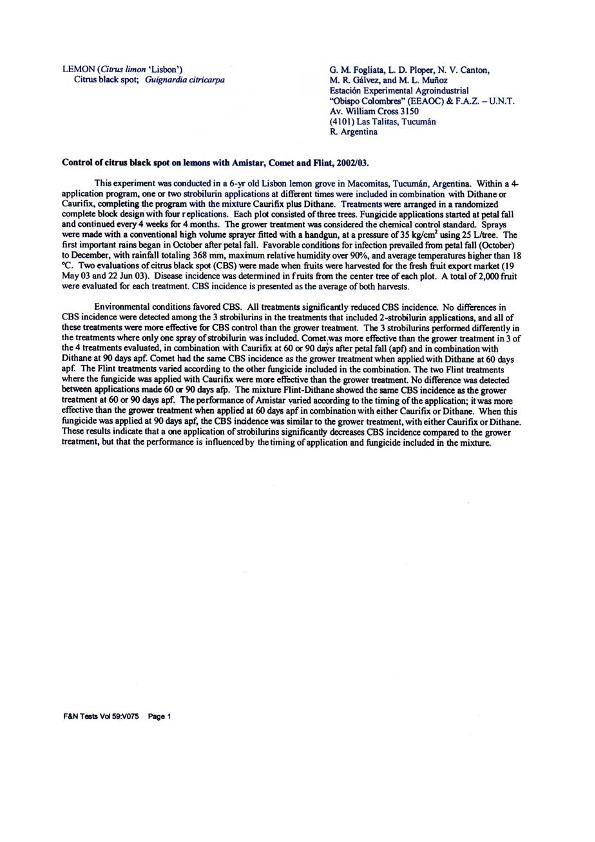
This experiment was conducted in a 6-yr old Lisbon lemon grove in Macomitas, Tucumán, Argentina. Within a 4-application program, one or two strobilurin applications at different times were included in combination with Dithane or Caurifix, completing the program with the mixture Caurifix plus Dithane. Treatments were arranged in a randomized complete block design with four replications. Each plot consisted of three trees. Fungicide applications started at petal fall and continued every 4 weeks for 4 months. The grower treatment was considered the chemical control standard. Sprays were made with a conventional high volume sprayer fitted with a handgun, at a pressure of 500 psi using 25 L/tree. The first important rains began in October after petal fall. Favorable conditions for infection prevailed from petal fall (October) to December, with rainfall totaling 368 mm, maximum relative humidity over 90%, and average temperatures higher than 18 ºC. Two evaluations of citrus black spot (CBS) were made when fruits were harvested for the fresh fruit export market (19 May 03 and 22 Jun 03). Disease incidence was determined in fruits from the center tree of each plot. A total of 2,000 fruits was evaluated for each treatment. CBS incidence is presented as the average of both harvests. Environmental conditions favored CBS. All treatments significantly reduced CBS incidence. No differences in CBS incidence were detected among the 3 strobilurins in the treatments that included 2-strobilurin applications, and all of these treatments were more effective for CBS control than the grower treatment. The 3 strobilurins performed differently in the treatments where only one spray of strobilurins was included. Comet was more effective than the grower treatment in 3 of the 4 treatments evaluated, in combination with Caurifix at 60 or 90 days after petal fall (apf) and in combination with Dithane at 90 days apf. Comet had the same CBS incidence as the grower treatment when applied with Dithane at 60 days apf. The Flint treatments varied according to the other fungicide included in the combination. The two Flint treatments where the fungicide was applied with Caurifix were more effective than the grower treatment. No difference was detected between applications made 60 or 90 days afp. The mixture Flint-Dithane showed the same CBS incidence as the grower treatment at 60 or 90 days apf. The performance of Amistar varied according to the timing of the application; it was more effective than the grower treatment when applied at 60 days apf in combination with either Caurifix or Dithane. When this fungicide was applied at 90 days apf, the CBS incidence was similar to the grower treatment, with either Caurifix or Dithane. These results indicate that a one application of strobilurins significantly decreases CBS incidence compared to the grower treatment, but that the performance is influenced by the timing of application and fungicide included in the mixture.
Palabras clave:
CITRUS LIMON
,
CHEMICAL CONTROL
,
GUIGNARDIA
Archivos asociados

Tamaño:
796.3Kb
Formato:
PDF
Licencia
 Excepto donde se diga explícitamente, este item se publica bajo la siguiente descripción:
Creative Commons Attribution-NonCommercial-ShareAlike 2.5 Unported (CC BY-NC-SA 2.5)
Excepto donde se diga explícitamente, este item se publica bajo la siguiente descripción:
Creative Commons Attribution-NonCommercial-ShareAlike 2.5 Unported (CC BY-NC-SA 2.5)
Identificadores
Colecciones
Articulos(CCT - NOA SUR)
Articulos de CTRO.CIENTIFICO TECNOL.CONICET - NOA SUR
Articulos de CTRO.CIENTIFICO TECNOL.CONICET - NOA SUR
Citación
Fogliata, G. M.; Ploper, Leonardo Daniel; Canton, Norma Virginia; Galvez, M. R.; Muñoz, L.; Control of citrus black spot on lemons with Amistar, Comet, and Flint, 2002/03. Fungicide and Nematicide Tests; The American Phytopathological Society; Fungicide And Nematicide Tests; 59; 75; 12-2004; 1-1
Compartir

