Artículo
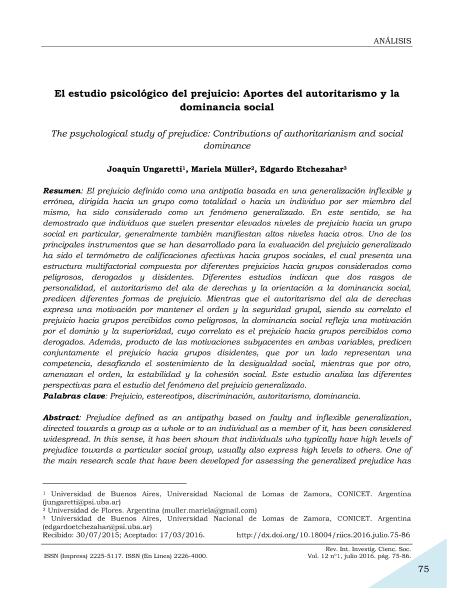
El prejuicio definido como una antipatía basada en una generalización inflexible y errónea, dirigida hacia un grupo como totalidad o hacia un individuo por ser miembro del mismo, ha sido considerado como un fenómeno generalizado. En este sentido, se ha demostrado que individuos que suelen presentar elevados niveles de prejuicio hacia un grupo social en particular, generalmente también manifiestan altos niveles hacia otros. Uno de los principales instrumentos que se han desarrollado para la evaluación del prejuicio generalizado ha sido el termómetro de calificaciones afectivas hacia grupos sociales, el cual presenta una estructura multifactorial compuesta por diferentes prejuicios hacia grupos considerados como peligrosos, derogados y disidentes. Diferentes estudios indican que dos rasgos de personalidad, el autoritarismo del ala de derechas y la orientación a la dominancia social, predicen diferentes formas de prejuicio. Mientras que el autoritarismo del ala de derechas expresa una motivación por mantener el orden y la seguridad grupal, siendo su correlato el prejuicio hacia grupos percibidos como peligrosos, la dominancia social refleja una motivación por el dominio y la superioridad, cuyo correlato es el prejuicio hacia grupos percibidos como derogados. Además, producto de las motivaciones subyacentes en ambas variables, predicen conjuntamente el prejuicio hacia grupos disidentes, que por un lado representan una competencia, desafiando el sostenimiento de la desigualdad social, mientras que por otro, amenazan el orden, la estabilidad y la cohesión social. Este estudio analiza las diferentes perspectivas para el estudio del fenómeno del prejuicio generalizado. Prejudice defined as an antipathy based on faulty and inflexible generalization, directed towards a group as a whole or to an individual as a member of it, has been considered widespread. In this sense, it has been shown that individuals who typically have high levels of prejudice towards a particular social group, usually also express high levels to others. One of the main research scale that have been developed for assessing the generalized prejudice has been the Affective Ratings Thermometer for Social Groups, which has a multifactorial structure composed of different prejudices against groups considered dangerous, derogated and dissidents. Several studies indicate that two personality traits, the right-wing authoritarianism and social dominance orientation, predict different forms of prejudice. While the right wing authoritarianism expresses a motivation to maintain the owns group order and security, being its counterpart prejudice against dangerous groups, social dominance reflects a motivation for dominance and superiority, whose correlate is prejudice towards derogated groups. In addition, due to the underlying motivations in both variables, they jointly predict prejudice to dissident groups, which in one hand represent a competition challenging the maintenance of social inequality, while on the other hand, threats the order, stability and social cohesion. The objective of this study was to analyze the different perspectives for studying the phenomenon of generalized prejudice.
El estudio psicológico del prejuicio: Aportes del autoritarismo y la dominancia social
Título:
The psychological study of prejudice: Contributions of authoritarianism and social dominance

Fecha de publicación:
07/2016
Editorial:
Universidad Autónoma de Asunción
Revista:
Revista Internacional de Investigación en Ciencias Sociales
ISSN:
2225-5117
e-ISSN:
2226-4000
Idioma:
Español
Tipo de recurso:
Artículo publicado
Clasificación temática:
Resumen
Palabras clave:
PREJUICIO
,
ESTEREOTIPOS
,
DISCRIMINACIÓN
,
AUTORITARISMO
Archivos asociados

Tamaño:
190.6Kb
Formato:
PDF
Licencia
 Excepto donde se diga explícitamente, este item se publica bajo la siguiente descripción:
Creative Commons Attribution 2.5 Unported (CC BY 2.5)
Excepto donde se diga explícitamente, este item se publica bajo la siguiente descripción:
Creative Commons Attribution 2.5 Unported (CC BY 2.5)
Identificadores
Colecciones
Articulos(SEDE CENTRAL)
Articulos de SEDE CENTRAL
Articulos de SEDE CENTRAL
Citación
Ungaretti, Joaquín; Müller, Mariela; Etchezahar, Edgardo Daniel; El estudio psicológico del prejuicio: Aportes del autoritarismo y la dominancia social; Universidad Autónoma de Asunción; Revista Internacional de Investigación en Ciencias Sociales; 12; 1; 7-2016; 75-86
Compartir


Altmétricas