Artículo
Joint species movement modeling: How do traits influence movements?
Ovaskainen, Otso; Leal Ramos, Danielle; Slade, Eleanor; Merckx, Thomas; Tikhonov, Gleb; Pennanen, Juho; Pizo, Marco Aurélio; Ribeiro, Milton Cezar; Morales, Juan Manuel
Fecha de publicación:
02/2019
Editorial:
Ecological Society of America
Revista:
Ecology
ISSN:
0012-9658
e-ISSN:
1939-9170
Idioma:
Inglés
Tipo de recurso:
Artículo publicado
Clasificación temática:
Resumen
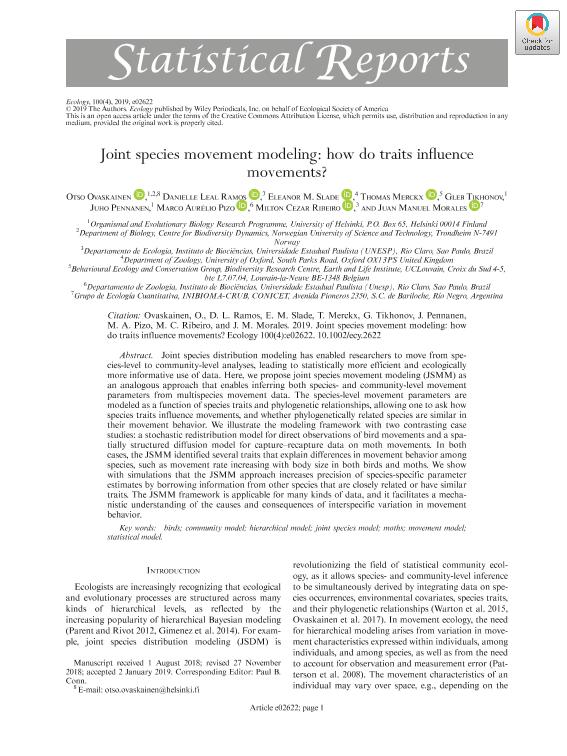
Joint species distribution modeling has enabled researchers to move from species‐level to community‐level analyses, leading to statistically more efficient and ecologically more informative use of data. Here, we propose joint species movement modeling (JSMM) as an analogous approach that enables inferring both species‐ and community‐level movement parameters from multispecies movement data. The species‐level movement parameters are modeled as a function of species traits and phylogenetic relationships, allowing one to ask how species traits influence movements, and whether phylogenetically related species are similar in their movement behavior. We illustrate the modeling framework with two contrasting case studies: a stochastic redistribution model for direct observations of bird movements and a spatially structured diffusion model for capture–recapture data on moth movements. In both cases, the JSMM identified several traits that explain differences in movement behavior among species, such as movement rate increasing with body size in both birds and moths. We show with simulations that the JSMM approach increases precision of species‐specific parameter estimates by borrowing information from other species that are closely related or have similar traits. The JSMM framework is applicable for many kinds of data, and it facilitates a mechanistic understanding of the causes and consequences of interspecific variation in movement behavior.
Palabras clave:
COMUNITY MODEL
,
HIERARCHICAL MODEL
,
MOVEMENT MODEL
Archivos asociados

Tamaño:
1.109Mb
Formato:
PDF
Licencia
 Excepto donde se diga explícitamente, este item se publica bajo la siguiente descripción:
Creative Commons Attribution 2.5 Unported (CC BY 2.5)
Excepto donde se diga explícitamente, este item se publica bajo la siguiente descripción:
Creative Commons Attribution 2.5 Unported (CC BY 2.5)
Identificadores
Colecciones
Articulos(INIBIOMA)
Articulos de INST. DE INVEST.EN BIODIVERSIDAD Y MEDIOAMBIENTE
Articulos de INST. DE INVEST.EN BIODIVERSIDAD Y MEDIOAMBIENTE
Citación
Ovaskainen, Otso; Leal Ramos, Danielle ; Slade, Eleanor; Merckx, Thomas; Tikhonov, Gleb; et al.; Joint species movement modeling: How do traits influence movements?; Ecological Society of America; Ecology; 100; 4; 2-2019; 1-8
Compartir


Altmétricas