Artículo
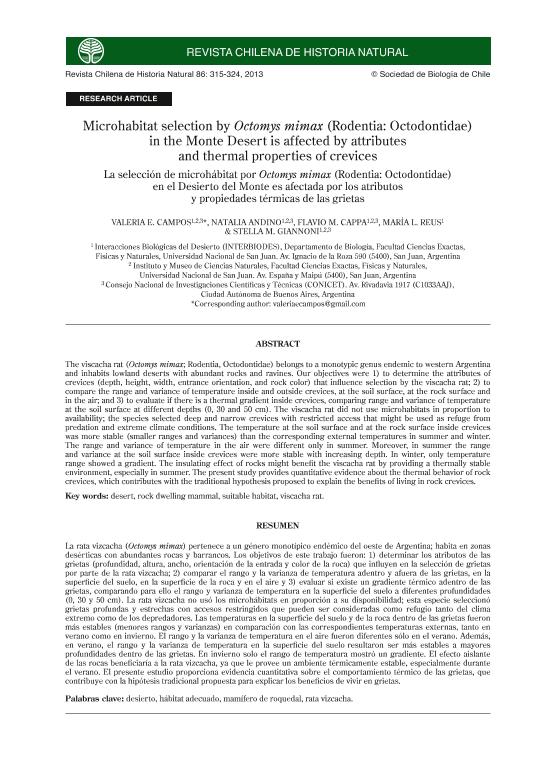
The viscacha rat (Octomys mimax; Rodentia, Octodontidae) belongs to a monotypic genus endemic to western Argentina and inhabits lowland deserts with abundant rocks and ravines. Our objectives were 1) to determine the attributes of crevices (depth, height, width, entrance orientation, and rock color) that influence selection by the viscacha rat; 2) to compare the range and variance of temperature inside and outside crevices, at the soil surface, at the rock surface and in the air; and 3) to evaluate if there is a thermal gradient inside crevices, comparing range and variance of temperature at the soil surface at different depths (0, 30 and 50 cm). The viscacha rat did not use microhabitats in proportion to availability; the species selected deep and narrow crevices with restricted access that might be used as refuge from predation and extreme climate conditions. The temperature at the soil surface and at the rock surface inside crevices was more stable (smaller ranges and variances) than the corresponding external temperatures in summer and winter. The range and variance of temperature in the air were different only in summer. Moreover, in summer the range and variance at the soil surface inside crevices were more stable with increasing depth. In winter, only temperature range showed a gradient. The insulating effect of rocks might benefit the viscacha rat by providing a thermally stable environment, especially in summer. The present study provides quantitative evidence about the thermal behavior of rock crevices, which contributes with the traditional hypothesis proposed to explain the benefits of living in rock crevices. La rata vizcacha (Octomys mimax) pertenece a un género monotípico endémico del oeste de Argentina; habita en zonas desérticas con abundantes rocas y barrancos. Los objetivos de este trabajo fueron: 1) determinar los atributos de las grietas (profundidad, altura, ancho, orientación de la entrada y color de la roca) que influyen en la selección de grietas por parte de la rata vizcacha; 2) comparar el rango y la varianza de temperatura adentro y afuera de las grietas, en la superficie del suelo, en la superficie de la roca y en el aire y 3) evaluar si existe un gradiente térmico adentro de las grietas, comparando para ello el rango y varianza de temperatura en la superficie del suelo a diferentes profundidades (0, 30 y 50 cm). La rata vizcacha no usó los microhábitats en proporción a su disponibilidad; esta especie seleccionó grietas profundas y estrechas con accesos restringidos que pueden ser consideradas como refugio tanto del clima extremo como de los depredadores. Las temperaturas en la superficie del suelo y de la roca dentro de las grietas fueron más estables (menores rangos y varianzas) en comparación con las correspondientes temperaturas externas, tanto en verano como en invierno. El rango y la varianza de temperatura en el aire fueron diferentes sólo en el verano. Además, en verano, el rango y la varianza de temperatura en la superficie del suelo resultaron ser más estables a mayores profundidades dentro de las grietas. En invierno solo el rango de temperatura mostró un gradiente. El efecto aislante de las rocas beneficiaría a la rata vizcacha, ya que le provee un ambiente térmicamente estable, especialmente durante el verano. El presente estudio proporciona evidencia cuantitativa sobre el comportamiento térmico de las grietas, que contribuye con la hipótesis tradicional propuesta para explicar los beneficios de vivir en grietas.
Microhabitat selection by Octomys mimax (Rodentia: Octodontidae) in the Monte Desert is affected by attributes and thermal properties of crevices
Título:
La selección de microhábitat por Octomys mimax (Rodentia: Octodontidae) en el Desierto del Monte es afectada por los atributos y propiedades térmicas de las grietas
Campos, Valeria Evelin ; Andino, Natalia del Pilar
; Cappa, Flavio Martín
; Reus, Maria Laura
; Giannoni, Stella Maris
; Andino, Natalia del Pilar
; Cappa, Flavio Martín
; Reus, Maria Laura
; Giannoni, Stella Maris
; Andino, Natalia del Pilar
; Cappa, Flavio Martín
; Reus, Maria Laura
; Giannoni, Stella Maris
Fecha de publicación:
06/2013
Editorial:
Sociedad de Biología de Chile
Revista:
Revista Chilena de Historia Natural
ISSN:
0716-078X
e-ISSN:
0717-6317
Idioma:
Inglés
Tipo de recurso:
Artículo publicado
Clasificación temática:
Resumen
Palabras clave:
Desert
,
Rock Dwelling Mammal
,
Suitable Habitat
,
Viscacha Rat
Archivos asociados

Tamaño:
126.2Kb
Formato:
PDF
Licencia
 Excepto donde se diga explícitamente, este item se publica bajo la siguiente descripción:
Creative Commons Attribution-NonCommercial-ShareAlike 2.5 Unported (CC BY-NC-SA 2.5)
Excepto donde se diga explícitamente, este item se publica bajo la siguiente descripción:
Creative Commons Attribution-NonCommercial-ShareAlike 2.5 Unported (CC BY-NC-SA 2.5)
Identificadores
Colecciones
Articulos(SEDE CENTRAL)
Articulos de SEDE CENTRAL
Articulos de SEDE CENTRAL
Citación
Campos, Valeria Evelin; Andino, Natalia del Pilar; Cappa, Flavio Martín; Reus, Maria Laura; Giannoni, Stella Maris; Microhabitat selection by Octomys mimax (Rodentia: Octodontidae) in the Monte Desert is affected by attributes and thermal properties of crevices; Sociedad de Biología de Chile; Revista Chilena de Historia Natural; 86; 3; 6-2013; 315-324
Compartir

