Artículo
Paralichthys patagonicus
Riestra, Cecilia Micaela; Díaz de Astarloa, Juan Martín ; Vieira, J. P.; Buratti, C.; Irigoyen, A.; Landaeta, M.; Hune, M.
; Vieira, J. P.; Buratti, C.; Irigoyen, A.; Landaeta, M.; Hune, M.
Fecha de publicación:
05/2020
Editorial:
International Union for Conservation of Nature
Revista:
The IUCN Red List of Threatened Species
ISSN:
2307-8235
Idioma:
Inglés
Tipo de recurso:
Artículo publicado
Clasificación temática:
Resumen
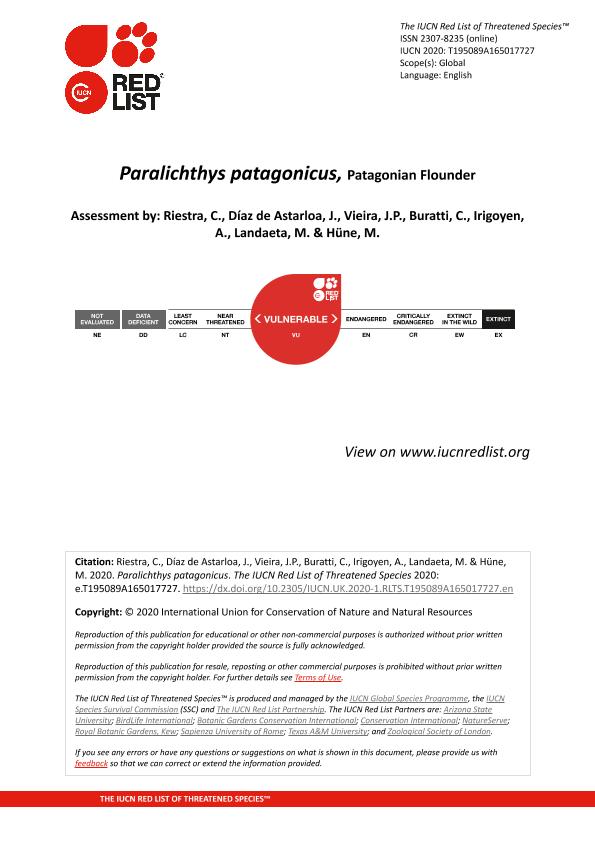
This demersal species occurs from southern Brazil to northern Argentina and is taken in multi-speciescommercial fisheries that target demersal fishes through much of its range. For purposes of thisassessment, half of the global population is considered to occur in Brazil and the other half in Uruguayand Argentina. According to landings and catch per unit effort data, the population in Brazil isoverexploited and declined by at least 30-60% over the past three generation lengths, or about a 30-year time period. According to stock assessment and fisheries data, there is no decline detected in thedemersal fish stock in Argentina and Uruguay and abundance indices show an increase in recent years(since 2014). Fishing effort continues at an unsustainable level in Brazil, the fishery is not well-monitoredand conservation measures are insufficient. Conservation measures in Argentina and Uruguay include atotal allowable catch limit and regular monitoring of stock status. In addition to fishing, this species isexposed to pollution in estuaries that may be impacting the survivability of some individuals. Based ondeclines in half of its global population (Brazil), at least a 30% global-level decline is suspected to haveoccurred over the past three generation lengths; therefore, it is listed as Vulnerable A2bcd. It isrecommended to improve fisheries monitoring, including the collection of species-specific data, as wellas implement conservation measures to reduce effort in Brazilian fisheries.
Palabras clave:
PARALICHTHYS
,
PATAGONICUS
,
ASSESSMENT
,
SOUTHWEST ATLANTIC
Archivos asociados

Tamaño:
1.340Mb
Formato:
PDF
Licencia
 Excepto donde se diga explícitamente, este item se publica bajo la siguiente descripción:
Creative Commons Attribution-NonCommercial-ShareAlike 2.5 Unported (CC BY-NC-SA 2.5)
Excepto donde se diga explícitamente, este item se publica bajo la siguiente descripción:
Creative Commons Attribution-NonCommercial-ShareAlike 2.5 Unported (CC BY-NC-SA 2.5)
Identificadores
Colecciones
Articulos(IIMYC)
Articulos de INSTITUTO DE INVESTIGACIONES MARINAS Y COSTERAS
Articulos de INSTITUTO DE INVESTIGACIONES MARINAS Y COSTERAS
Citación
Riestra, Cecilia Micaela; Díaz de Astarloa, Juan Martín; Vieira, J. P.; Buratti, C.; Irigoyen, A.; et al.; Paralichthys patagonicus; International Union for Conservation of Nature; The IUCN Red List of Threatened Species; 5-2020; 1-12
Compartir


Altmétricas