Mostrar el registro sencillo del ítem
dc.contributor.author
Richtler, T.
dc.contributor.author
Hilker, M.
dc.contributor.author
Kumar, B.
dc.contributor.author
Bassino, Lilia Patricia
dc.contributor.author
Gomez, M.
dc.contributor.author
Dirsch, B.
dc.date.available
2017-01-05T20:33:13Z
dc.date.issued
2014-09
dc.identifier.citation
Richtler, T.; Hilker, M.; Kumar, B.; Bassino, Lilia Patricia; Gomez, M.; et al.; The globular cluster system of NGC1316: III. Kinematic complexity; Edp Sciences; Astronomy And Astrophysics; 569; 9-2014; 1-18; A41
dc.identifier.issn
0004-6361
dc.identifier.uri
http://hdl.handle.net/11336/10892
dc.description.abstract
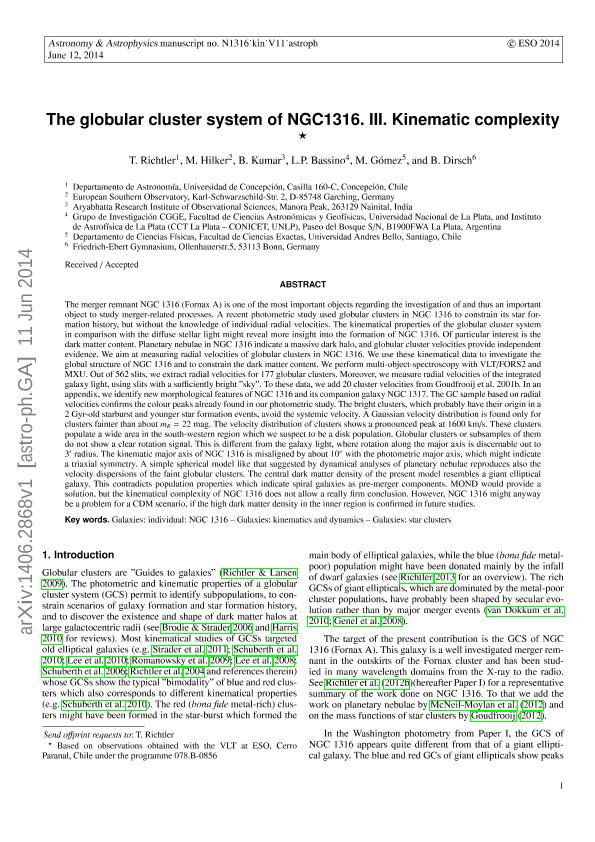
Defining photometric peculiar type Ia Supernovae The merger remnant NGC 1316 (Fornax A) is one of the most important objects regarding the investigation of and thus an important object to study merger-related processes. A recent photometric study used globular clusters in NGC 1316 to constrain its star formation history, but without the knowledge of individual radial velocities. The kinematical properties of the globular cluster system in comparison with the diffuse stellar light might reveal more insight into the formation of NGC 1316. Of particular interest is the dark matter content. Planetary nebulae in NGC 1316 indicate a massive dark halo, and globular cluster velocities provide independent evidence. We aim at measuring radial velocities of globular clusters in NGC 1316. We use these kinematical data to investigate the global structure of NGC 1316 and to constrain the dark matter content. We perform multi-object-spectroscopy with VLT/FORS2 and MXU. Out of 562 slits, we extract radial velocities for 177 globular clusters. Moreover, we measure radial velocities of the integrated galaxy light, using slits with a sufficiently bright ”sky”. To these data, we add 20 cluster velocities from Goudfrooij et al. 2001b. In an appendix, we identify new morphological features of NGC 1316 and its companion galaxy NGC 1317. The GC sample based on radial velocities confirms the colour peaks already found in our photometric study. The bright clusters, which probably have their origin in a 2 Gyr-old starburst and younger star formation events, avoid the systemic velocity. A Gaussian velocity distribution is found only for clusters fainter than about mR = 22 mag. The velocity distribution of clusters shows a pronounced peak at 1600 km/s. These clusters populate a wide area in the south-western region which we suspect to be a disk population. Globular clusters or subsamples of them do not show a clear rotation signal. This is different from the galaxy light, where rotation along the major axis is discernable out to 3 0 radius. The kinematic major axis of NGC 1316 is misaligned by about 10◦ with the photometric major axis, which might indicate a triaxial symmetry. A simple spherical model like that suggested by dynamical analyses of planetary nebulae reproduces also the velocity dispersions of the faint globular clusters. The central dark matter density of the present model resembles a giant elliptical galaxy. This contradicts population properties which indicate spiral galaxies as pre-merger components. MOND would provide a solution, but the kinematical complexity of NGC 1316 does not allow a really firm conclusion. However, NGC 1316 might anyway be a problem for a CDM scenario, if the high dark matter density in the inner region is confirmed in future studies.
dc.format
application/pdf
dc.language.iso
eng
dc.publisher
Edp Sciences
dc.rights
info:eu-repo/semantics/openAccess
dc.rights.uri
https://creativecommons.org/licenses/by/2.5/ar/
dc.subject
Galaxies
dc.subject
Ngc 1316
dc.subject
Kinematics And Dynamics
dc.subject
Star Clusters
dc.subject.classification
Astronomía
dc.subject.classification
Ciencias Físicas
dc.subject.classification
CIENCIAS NATURALES Y EXACTAS
dc.title
The globular cluster system of NGC1316: III. Kinematic complexity
dc.type
info:eu-repo/semantics/article
dc.type
info:ar-repo/semantics/artículo
dc.type
info:eu-repo/semantics/publishedVersion
dc.date.updated
2017-01-02T18:36:27Z
dc.identifier.eissn
1432-0746
dc.journal.volume
569
dc.journal.pagination
1-18; A41
dc.journal.pais
Francia
dc.journal.ciudad
Paris
dc.description.fil
Fil: Richtler, T.. Universidad de Concepción; Chile
dc.description.fil
Fil: Hilker, M.. European Southern Observatory; Alemania
dc.description.fil
Fil: Kumar, B.. Aryabhatta Research Institute Of Observational Sciences; India
dc.description.fil
Fil: Bassino, Lilia Patricia. Consejo Nacional de Investigaciones Científicas y Técnicas. Centro Científico Tecnológico la Plata. Instituto de Astrofísica de la Plata; Argentina. Universidad Nacional de la Plata. Facultad de Ciencias Astronómicas y Geofísicas; Argentina
dc.description.fil
Fil: Gomez, M.. Universidad Andres Bello; Chile
dc.description.fil
Fil: Dirsch, B.. Friedrich-Ebert Gymnasium; Alemania
dc.journal.title
Astronomy And Astrophysics
dc.relation.alternativeid
info:eu-repo/semantics/altIdentifier/doi/http://dx.doi.org/10.1051/0004-6361/201423525
dc.relation.alternativeid
info:eu-repo/semantics/altIdentifier/url/http://www.aanda.org/articles/aa/abs/2014/09/aa23525-14/aa23525-14.html
dc.relation.alternativeid
info:eu-repo/semantics/altIdentifier/url/https://arxiv.org/abs/1406.2868
Archivos asociados

Tamaño:
4.461Mb
Formato:
PDF