Artículo
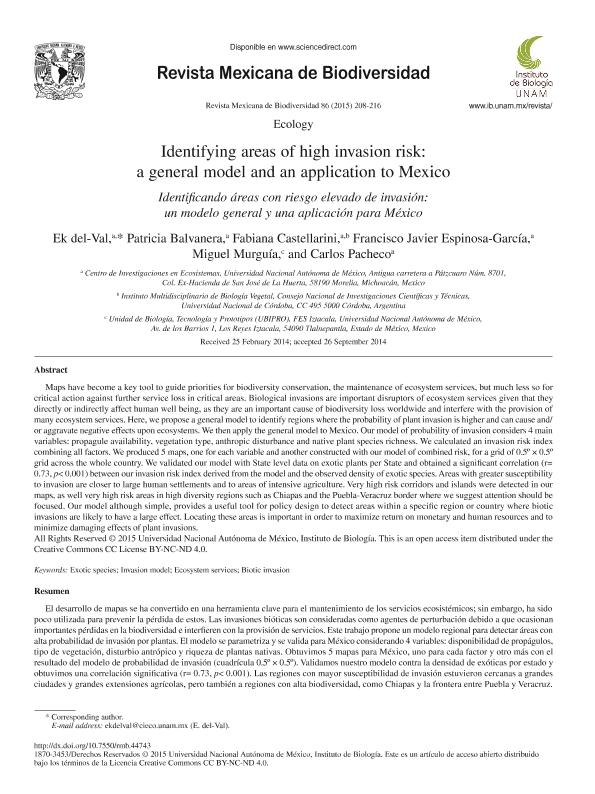
El desarrollo de mapas se ha convertido en una herramienta clave para el mantenimiento de los servicios ecosistémicos; sin embargo, ha sido poco utilizada para prevenir la pérdida de estos. Las invasiones bióticas son consideradas como agentes de perturbación debido a que ocasionan importantes pérdidas en la biodiversidad e interfieren con la provisión de servicios. Este trabajo propone un modelo regional para detectar áreas con alta probabilidad de invasión por plantas. El modelo se parametriza y se valida para México considerando 4 variables: disponibilidad de propágulos, tipo de vegetación, disturbio antrópico y riqueza de plantas nativas. Obtuvimos 5 mapas para México, uno para cada factor y otro más con el resultado del modelo de probabilidad de invasión (cuadrícula 0.5° × 0.5°). Validamos nuestro modelo contra la densidad de exóticas por estado y obtuvimos una correlación significativa (r= 0.73, p< 0.001). Las regiones con mayor susceptibilidad de invasión estuvieron cercanas a grandes ciudades y grandes extensiones agrícolas, pero también a regiones con alta biodiversidad, como Chiapas y la frontera entre Puebla y Veracruz. Maps have become a key tool to guide priorities for biodiversity conservation, the maintenance of ecosystem services, but much less so for critical action against further service loss in critical areas. Biological invasions are important disruptors of ecosystem services given that they directly or indirectly affect human well being, as they are an important cause of biodiversity loss worldwide and interfere with the provision of many ecosystem services. Here, we propose a general model to identify regions where the probability of plant invasion is higher and can cause and/or aggravate negative effects upon ecosystems. We then apply the general model to Mexico. Our model of probability of invasion considers 4 main variables: propagule availability, vegetation type, anthropic disturbance and native plant species richness. We calculated an invasion risk index combining all factors. We produced 5 maps, one for each variable and another constructed with our model of combined risk, for a grid of 0.5° × 0.5° grid across the whole country. We validated our model with State level data on exotic plants per State and obtained a significant correlation (r= 0.73, p< 0.001) between our invasion risk index derived from the model and the observed density of exotic species. Areas with greater susceptibility to invasion are closer to large human settlements and to areas of intensive agriculture. Very high risk corridors and islands were detected in our maps, as well very high risk areas in high diversity regions such as Chiapas and the Puebla-Veracruz border where we suggest attention should be focused. Our model although simple, provides a useful tool for policy design to detect areas within a specific region or country where biotic invasions are likely to have a large effect. Locating these areas is important in order to maximize return on monetary and human resources and to minimize damaging effects of plant invasions.
Identifying areas of high invasion risk: A general model and an application to Mexico
Título:
Identificando áreas con riesgo elevado de invasión: un modelo general y una aplicación para México
del Val, Ek; Balvanera, Patricia; Castellarini, Fabiana ; Espinosa García, Francisco Javier; Murguía, Miguel; Pacheco, Carlos
; Espinosa García, Francisco Javier; Murguía, Miguel; Pacheco, Carlos
Fecha de publicación:
03/2015
Editorial:
Universidad Nacional Autónoma de México. Instituto de Biología
Revista:
Revista Mexicana de Biodiversidad
ISSN:
1870-3453
e-ISSN:
2007-8706
Idioma:
Inglés
Tipo de recurso:
Artículo publicado
Clasificación temática:
Resumen
Archivos asociados

Tamaño:
1.656Mb
Formato:
PDF
Licencia
 Excepto donde se diga explícitamente, este item se publica bajo la siguiente descripción:
Atribución-NoComercial-SinDerivadas 2.5 Argentina (CC BY-NC-ND 2.5 AR)
Excepto donde se diga explícitamente, este item se publica bajo la siguiente descripción:
Atribución-NoComercial-SinDerivadas 2.5 Argentina (CC BY-NC-ND 2.5 AR)
Identificadores
Colecciones
Articulos(IMBIV)
Articulos de INST.MULTIDISCIPL.DE BIOLOGIA VEGETAL (P)
Articulos de INST.MULTIDISCIPL.DE BIOLOGIA VEGETAL (P)
Citación
del Val, Ek; Balvanera, Patricia; Castellarini, Fabiana; Espinosa García, Francisco Javier; Murguía, Miguel; et al.; Identifying areas of high invasion risk: A general model and an application to Mexico; Universidad Nacional Autónoma de México. Instituto de Biología; Revista Mexicana de Biodiversidad; 86; 1; 3-2015; 208-216
Compartir


Altmétricas