Artículo
SARS-CoV-2 Pathogenesis: Imbalance in the Renin-Angiotensin System Favors Lung Fibrosis

Fecha de publicación:
06/2020
Editorial:
Frontiers Research Foundation
Revista:
Frontiers in Cellular and Infection Microbiology
e-ISSN:
2235-2988
Idioma:
Inglés
Tipo de recurso:
Artículo publicado
Clasificación temática:
Resumen
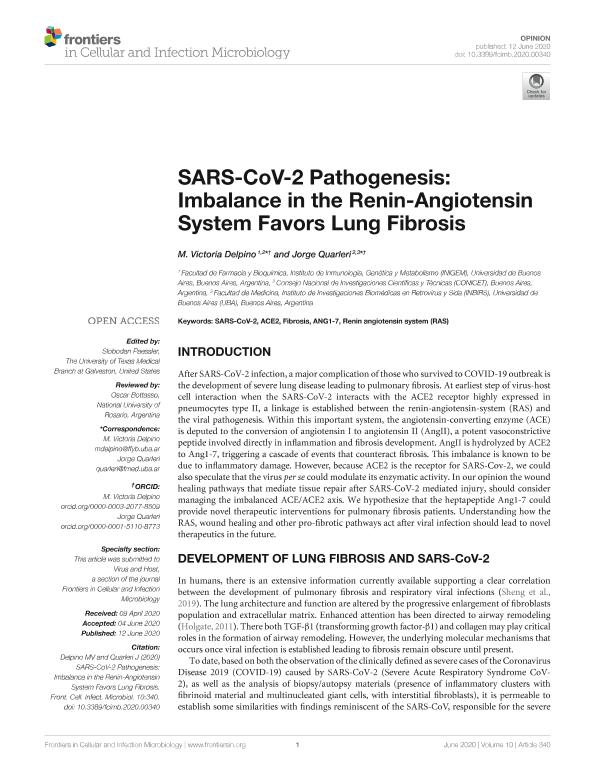
After SARS-CoV-2 infection, a major complication of those who survived to COVID-19 outbreak is the development of severe lung disease leading to pulmonary fibrosis. At earliest step of virus-host cell interaction when the SARS-CoV-2 interacts with the ACE2 receptor highly expressed in pneumocytes type II, a linkage is established between the renin-angiotensin-system (RAS) and the viral pathogenesis. Within this important system, the angiotensin-converting enzyme (ACE) is deputed to the conversion of angiotensin I to angiotensin II (AngII), a potent vasoconstrictive peptide involved directly in inflammation and fibrosis development. AngII is hydrolyzed by ACE2 to Ang1-7, triggering a cascade of events that counteract fibrosis. This imbalance is known to be due to inflammatory damage. However, because ACE2 is the receptor for SARS-Cov-2, we could also speculate that the virus per se could modulate its enzymatic activity. In our opinion the wound healing pathways that mediate tissue repair after SARS-CoV-2 mediated injury, should consider managing the imbalanced ACE/ACE2 axis. We hypothesize that the heptapeptide Ang1-7 could provide novel therapeutic interventions for pulmonary fibrosis patients. Understanding how the RAS, wound healing and other pro-fibrotic pathways act after viral infection should lead to novel therapeutics in the future.
Palabras clave:
SARS-COV-2
,
ACE2
,
FIBROSIS
,
RENIN ANGIOTENSIN SYSTEM (RAS)
,
ANG1-7
,
COVID-19
Archivos asociados

Tamaño:
411.8Kb
Formato:
PDF
Licencia
 Excepto donde se diga explícitamente, este item se publica bajo la siguiente descripción:
Creative Commons Attribution 2.5 Unported (CC BY 2.5)
Excepto donde se diga explícitamente, este item se publica bajo la siguiente descripción:
Creative Commons Attribution 2.5 Unported (CC BY 2.5)
Identificadores
Colecciones
Articulos(INBIRS)
Articulos de INSTITUTO DE INVESTIGACIONES BIOMEDICAS EN RETROVIRUS Y SIDA
Articulos de INSTITUTO DE INVESTIGACIONES BIOMEDICAS EN RETROVIRUS Y SIDA
Citación
Delpino, María Victoria; Quarleri, Jorge Fabian; SARS-CoV-2 Pathogenesis: Imbalance in the Renin-Angiotensin System Favors Lung Fibrosis; Frontiers Research Foundation; Frontiers in Cellular and Infection Microbiology; 10; 6-2020; 1-5
Compartir


Altmétricas