Artículo
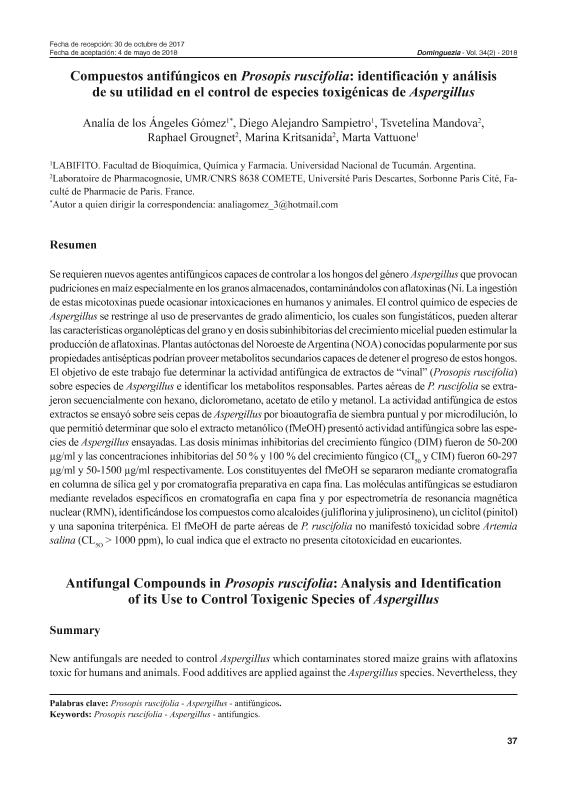
Se requieren nuevos agentes antifúngicos capaces de controlar a los hongos del género Aspergillus que provocan pudriciones en maíz especialmente en los granos almacenados, contaminándolos con aflatoxinas. La ingestión de estas micotoxinas puede ocasionar intoxicaciones en humanos y animales. El control químico de especies de Aspergillus se restringe al uso de preservantes de grado limenticio, los cuales son fungistáticos, pueden alterar las características organolépticas del grano y en dosis subinhibitorias del crecimiento micelial pueden estimular a producción de aflatoxinas. Plantas autóctonas del Noroeste de Argentina (NOA) conocidas popularmente por sus propiedades antisépticas podrían proveer metabolitos secundarios capaces de detener el progreso de estos hongos. El objetivo de este trabajo fue determinar la actividad antifúngica de extractos de vinal (Prosopis ruscifolia) sobre especies de Aspergillus e identificar los metabolitos responsables. Partes aéreas de P. ruscifolia se extrajeron secuencialmente con hexano, diclorometano, acetato de etilo y metanol. La actividad antifúngica de estos extractos se ensayó sobre seis cepas de Aspergillus por bioautografía de siembra puntual y por microdilución, loque permitió determinar que solo el extracto metanólico (fMeOH) presentó actividad antifúngica sobre las especies de Aspergillus ensayadas. Las dosis mínimas inhibitorias del crecimiento fúngico (DIM) fueron de 50-200 µg/ml y las concentraciones inhibitorias del 50 % y 100 % del crecimiento fúngico (CI50 y CIM) fueron 60-297 µg/ml y 50-1500 µg/ml respectivamente. Los constituyentes del fMeOH se separaron mediante cromatografía en columna de sílica gel y por cromatografía preparativa en capa fina. Las moléculas antifúngicas se estudiaron mediante revelados específicos en cromatografía en capa fina y por espectrometría de resonancia magnética nuclear (RMN), identificándose los compuestos como alcaloides (juliflorina y juliprosineno), un ciclitol (pinitol) y una saponina triterpénica. El fMeOH de parte aéreas de P. ruscifolia no manifestó toxicidad sobre Artemia salina (CL5O > 1000 ppm), lo cual indica que el extracto no presenta citotoxicidad en eucariontes. New antifungals are needed to control Aspergillus which contaminates stored maize grains with aflatoxins toxic for humans and animals. Food additives are applied against the Aspergillus species. Nevertheless, they fungistatic, can change grain organoleptic properties and can stimulate aflatoxin production at sub-inhibitory levels. Native plants used in popular medicine as antiseptics could provide antimicrobials useful in the control of Aspergillus. The aim of this work was to determine the antifungal activity of extracts from “vinal” (Prosopis ruscifolia) against Aspergillus species and to identify its antifungal metabolites. Aerial parts of P. ruscifolia were sequentially extracted with hexane, dichloromethane, ethyl acetate and methanol. Antifungal activity of these extracts was tested against six strains of Aspergillus by dot blot bioautography and the mi-crodilution method. These data were used to calculate the minimum inhibitory dose of fungal growth (MID) 38Gómez y col.are fungistatic, can change grain organoleptic properties and can stimulate aflatoxin production at sub-inhibi-tory levels. Native plants used in popular medicine as antiseptics could provide antimicrobials useful in the control of Aspergillus. The aim of this work was to determine the antifungal activity of extracts from “vinal” (Prosopis ruscifolia) against Aspergillus species and to identify its antifungal metabolites. Aerial parts of P. ruscifolia were sequentially extracted with hexane, dichloromethane, ethyl acetate and methanol. Antifungal activity of these extracts was tested against six strains of Aspergillus by dot blot bioautography and the mi-crodilution method. These data were used to calculate the minimum inhibitory dose of fungal growth (MID) and the concentrations required to inhibit 50 % (IC50) and 100 % (MIC) of the fungal growth. Constituents of the bioactive extract was separated by column chromatography and preparative thin layer chromatography (PTLC) in silica gel. Antifungal molecules were preliminarily identified by TLC and subsequently by nuclear magnetic resonance (NMR) spectroscopy. Only the methanolic extract showed antifungal activity against Aspergillus strains (IC50 of 60-297 micrograms per mililiter. Antifungal components were identified as alkaloids (juliflorine and prosoflorine), cyclitol (pinitol) and triterpene saponins.
Compuestos antifúngicos en Prosopis ruscifolia: identificación y análisis de su utilidad en el control de especies toxigénicas de Aspergillus
Título:
Antifungal compounds in Prosopis ruscifolia: Analysis and identificationof its use to control toxigenic species of Aspergillus
Gomez, Analía de los Ángeles; Sampietro, Diego Alejandro ; Mandova, Tsvetelina; Grougnet, Raphael; Kritsanida, Marina; Vattuone, Marta Amelia
; Mandova, Tsvetelina; Grougnet, Raphael; Kritsanida, Marina; Vattuone, Marta Amelia
Fecha de publicación:
04/2018
Editorial:
Museo de Farmacobotánica "Juan A. Domínguez"
Revista:
Dominguezia
ISSN:
1669-6859
Idioma:
Español
Tipo de recurso:
Artículo publicado
Clasificación temática:
Resumen
Palabras clave:
ANTIFUNGICO
,
PROSOPIS
,
VINAL
Archivos asociados

Tamaño:
1.899Mb
Formato:
PDF
Licencia
 Excepto donde se diga explícitamente, este item se publica bajo la siguiente descripción:
Creative Commons Attribution-NonCommercial-ShareAlike 2.5 Unported (CC BY-NC-SA 2.5)
Excepto donde se diga explícitamente, este item se publica bajo la siguiente descripción:
Creative Commons Attribution-NonCommercial-ShareAlike 2.5 Unported (CC BY-NC-SA 2.5)
Identificadores
Colecciones
Articulos(CCT - NOA SUR)
Articulos de CTRO.CIENTIFICO TECNOL.CONICET - NOA SUR
Articulos de CTRO.CIENTIFICO TECNOL.CONICET - NOA SUR
Citación
Gomez, Analía de los Ángeles; Sampietro, Diego Alejandro; Mandova, Tsvetelina; Grougnet, Raphael; Kritsanida, Marina; et al.; Compuestos antifúngicos en Prosopis ruscifolia: identificación y análisis de su utilidad en el control de especies toxigénicas de Aspergillus; Museo de Farmacobotánica "Juan A. Domínguez"; Dominguezia; 34; 2; 4-2018; 37-45
Compartir

