Artículo
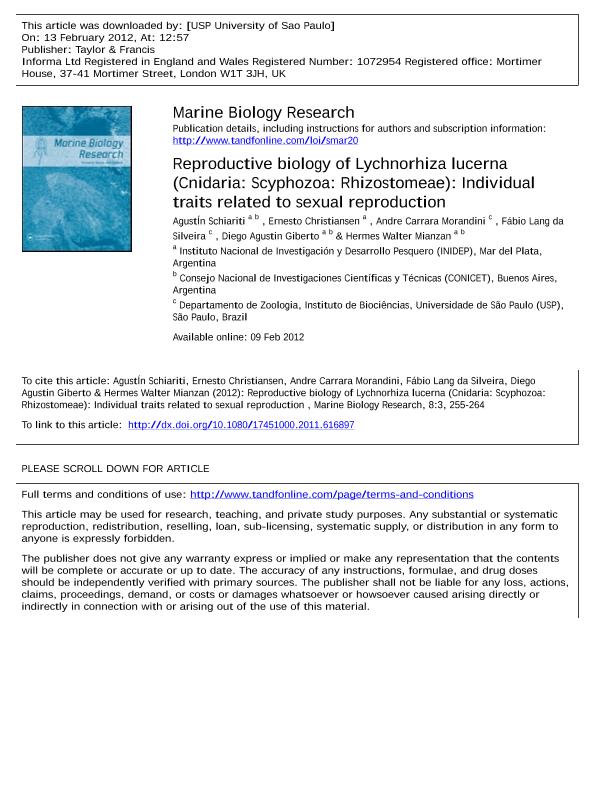
Reproductive biology of Lychnorhiza lucerna (Cnidaria: Scyphozoa: Rhizostomeae): Individual traits related to sexual reproduction
Schiariti, Agustin ; Christiansen, Enesto; Morandini, Andre Carrara; da Silveira, Fabio Lang; Giberto, Diego Agustin
; Mianzan, Hermes Walter
; Christiansen, Enesto; Morandini, Andre Carrara; da Silveira, Fabio Lang; Giberto, Diego Agustin
; Mianzan, Hermes Walter
; Christiansen, Enesto; Morandini, Andre Carrara; da Silveira, Fabio Lang; Giberto, Diego Agustin
; Mianzan, Hermes Walter
Fecha de publicación:
02/2012
Editorial:
Taylor & Francis As
Revista:
Marine Biology Research
ISSN:
1745-1000
Idioma:
Inglés
Tipo de recurso:
Artículo publicado
Clasificación temática:
Resumen
We studied individual traits related with sexual reproduction of Lychnorhiza lucerna and review how sexual maturation has been studied for scyphomedusae, focusing on the particular case of non-brooding species. L. lucerna is a gonochoric species and sexual dimorphism was found in the colour of the gonads. There were no brooding structures or any other distinguishable feature that enable macroscopic determination of sex. Gametogenesis in L. lucerna resembled the descriptions available for other rhizostomes and semaeostomes. Both processes are asynchronous since gametes at all stages of development occurred simultaneously. Oocytes arose from the gastrodermis and maintained contact with it via trophocytes throughout vitellogenesis. Spermatogenesis occurred within the spermatic follicles arising from nested primary spermatogonia in the mesoglea. Population features of sexual reproduction are defined by characterizing and quantifying individuals at different stages of sexual maturity. Regarding sexual maturation in Scyphozoa, sexually mature medusae can be detected by i) the presence of fully-developed gametes in the gonads indicating near future spawning, or ii) by the presence of spent spermatic follicles as evidence of ongoing or recent spawning events. Whereas the former allows getting a more detailed study of sexual reproduction patterns of any species, the later constitutes an option for non-brooders equivalent to the search of fertilized eggs or planulae for brooder species, as exemplified in this work.
Palabras clave:
NON-BROODER SPECIES
,
OOGENESIS
,
SEXUAL MATURITY
,
SPERMATOGENESIS
Archivos asociados

Tamaño:
531.2Kb
Formato:
PDF
Licencia
 Excepto donde se diga explícitamente, este item se publica bajo la siguiente descripción:
Creative Commons Attribution-NonCommercial-ShareAlike 2.5 Unported (CC BY-NC-SA 2.5)
Excepto donde se diga explícitamente, este item se publica bajo la siguiente descripción:
Creative Commons Attribution-NonCommercial-ShareAlike 2.5 Unported (CC BY-NC-SA 2.5)
Identificadores
Colecciones
Articulos(IIMYC)
Articulos de INSTITUTO DE INVESTIGACIONES MARINAS Y COSTERAS
Articulos de INSTITUTO DE INVESTIGACIONES MARINAS Y COSTERAS
Citación
Schiariti, Agustin; Christiansen, Enesto; Morandini, Andre Carrara; da Silveira, Fabio Lang; Giberto, Diego Agustin; et al.; Reproductive biology of Lychnorhiza lucerna (Cnidaria: Scyphozoa: Rhizostomeae): Individual traits related to sexual reproduction; Taylor & Francis As; Marine Biology Research; 8; 3; 2-2012; 255-264
Compartir


Altmétricas