Artículo
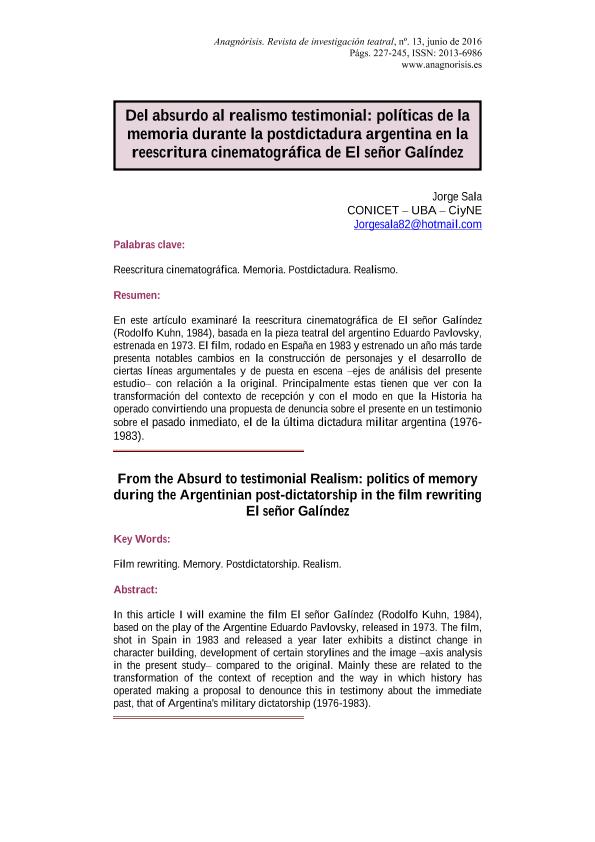
En este artículo examinaré la reescritura cinematográfica de El señor Galíndez (Rodolfo Kuhn, 1984), basada en la pieza teatral del argentino Eduardo Pavlovsky, estrenada en 1973. El film, rodado en España en 1983 y estrenado un año más tarde presenta notables cambios en la construcción de personajes y el desarrollo de ciertas líneas argumentales y de puesta en escena –ejes de análisis del presente estudio– con relación a la original. Principalmente estas tienen que ver con la transformación del contexto de recepción y con el modo en que la Historia ha operado convirtiendo una propuesta de denuncia sobre el presente en un testimonio sobre el pasado inmediato, el de la última dictadura militar argentina (1976- 1983). In this article I will examine the film El señor Galíndez (Rodolfo Kuhn, 1984), based on the play of the Argentine Eduardo Pavlovsky, released in 1973. The film, shot in Spain in 1983 and released a year later exhibits a distinct change in character building, development of certain storylines and the image –axis analysis in the present study– compared to the original. Mainly these are related to the transformation of the context of reception and the way in which history has operated making a proposal to denounce this in testimony about the immediate past, that of Argentina's military dictatorship (1976-1983).
Del absurdo al realismo testimonial: políticas de la memoria durante la postdictadura argentina en la reescritura cinematográfica de El señor Galíndez
Título:
From the Absurd to testimonial Realism: politics of memory during the Argentinian post-dictatorship in the film rewriting El señor Galíndez

Fecha de publicación:
06/2016
Editorial:
Universidad de Barcelona
Revista:
Anagnórisis
ISSN:
2013-6986
Idioma:
Español
Tipo de recurso:
Artículo publicado
Clasificación temática:
Resumen
Palabras clave:
Reescritura cinematográfica
,
Postdictadura
,
Memoria
,
Realismo
Archivos asociados

Tamaño:
563.8Kb
Formato:
PDF
Licencia
 Excepto donde se diga explícitamente, este item se publica bajo la siguiente descripción:
Creative Commons Attribution-NonCommercial-ShareAlike 2.5 Unported (CC BY-NC-SA 2.5)
Excepto donde se diga explícitamente, este item se publica bajo la siguiente descripción:
Creative Commons Attribution-NonCommercial-ShareAlike 2.5 Unported (CC BY-NC-SA 2.5)
Identificadores
Colecciones
Articulos(SEDE CENTRAL)
Articulos de SEDE CENTRAL
Articulos de SEDE CENTRAL
Citación
Sala, Jorge Eduardo; Del absurdo al realismo testimonial: políticas de la memoria durante la postdictadura argentina en la reescritura cinematográfica de El señor Galíndez; Universidad de Barcelona; Anagnórisis; 13; 6-2016; 227-245
Compartir

