Artículo
Impact of the Placental Cytokine-Chemokine Balance on Regulation of Cell-Cell Contact-Induced Human Immunodeficiency Virus Type 1 Translocation across a Trophoblastic Barrier In Vitro
Derrien, Muriel; Faye, Albert; Dolcini, Guillermina Laura ; Chaouat, Gérard; Barré Sinoussi, Françoise; Menu, Elisabeth
; Chaouat, Gérard; Barré Sinoussi, Françoise; Menu, Elisabeth
Fecha de publicación:
10/2005
Editorial:
American Society for Microbiology
Revista:
Journal of Virology
ISSN:
0022-538X
e-ISSN:
1098-5514
Idioma:
Inglés
Tipo de recurso:
Artículo publicado
Clasificación temática:
Resumen
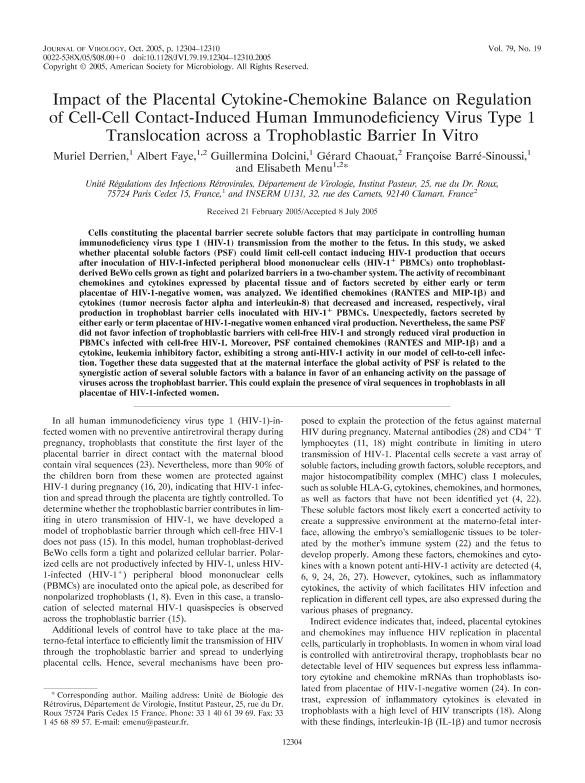
Cells constituting the placental barrier secrete soluble factors that may participate in controlling human immunodeficiency virus type 1 (HIV-1) transmission from the mother to the fetus. In this study, we asked whether placental soluble factors (PSF) could limit cell-cell contact inducing HIV-1 production that occurs after inoculation of HIV-1-infected peripheral blood mononuclear cells (HIV-1+ PBMCs) onto trophoblast-derived BeWo cells grown as tight and polarized barriers in a two-chamber system. The activity of recombinant chemokines and cytokines expressed by placental tissue and of factors secreted by either early or term placentae of HIV-1-negative women, was analyzed. We identified chemokines (RANTES and MIP-1beta) and cytokines (tumor necrosis factor alpha and interleukin-8) that decreased and increased, respectively, viral production in trophoblast barrier cells inoculated with HIV-1+ PBMCs. Unexpectedly, factors secreted by either early or term placentae of HIV-1-negative women enhanced viral production. Nevertheless, the same PSF did not favor infection of trophoblastic barriers with cell-free HIV-1 and strongly reduced viral production in PBMCs infected with cell-free HIV-1. Moreover, PSF contained chemokines (RANTES and MIP-1beta) and a cytokine, leukemia inhibitory factor, exhibiting a strong anti-HIV-1 activity in our model of cell-to-cell infection. Together these data suggested that at the maternal interface the global activity of PSF is related to the synergistic action of several soluble factors with a balance in favor of an enhancing activity on the passage of viruses across the trophoblast barrier. This could explain the presence of viral sequences in trophoblasts in all placentae of HIV-1-infected women.
Palabras clave:
CHEMOKINES
,
CYTOKINES
,
HIV-1
,
TROPHOBLASTS
Archivos asociados

Tamaño:
284.8Kb
Formato:
PDF
Licencia
 Excepto donde se diga explícitamente, este item se publica bajo la siguiente descripción:
Creative Commons Attribution-NonCommercial-ShareAlike 2.5 Unported (CC BY-NC-SA 2.5)
Excepto donde se diga explícitamente, este item se publica bajo la siguiente descripción:
Creative Commons Attribution-NonCommercial-ShareAlike 2.5 Unported (CC BY-NC-SA 2.5)
Identificadores
Colecciones
Articulos(CIVETAN)
Articulos de CENTRO DE INVESTIGACION VETERINARIA DE TANDIL
Articulos de CENTRO DE INVESTIGACION VETERINARIA DE TANDIL
Citación
Derrien, Muriel; Faye, Albert; Dolcini, Guillermina Laura; Chaouat, Gérard; Barré Sinoussi, Françoise; et al.; Impact of the Placental Cytokine-Chemokine Balance on Regulation of Cell-Cell Contact-Induced Human Immunodeficiency Virus Type 1 Translocation across a Trophoblastic Barrier In Vitro; American Society for Microbiology; Journal of Virology; 79; 19; 10-2005; 12304-12310
Compartir


Altmétricas