Artículo
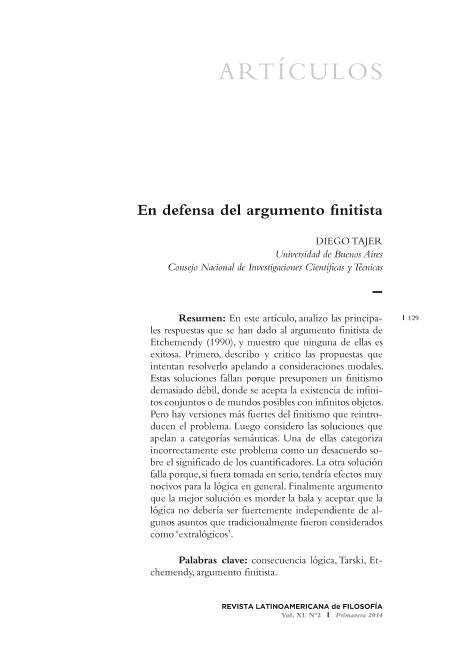
En este artículo, analizo las principales respuestas que se han dado al argumento finitista de Etchemendy (1990), y muestro que ninguna de ellas es exitosa. Primero, describo y critico las propuestas que intentan resolverlo apelando a consideraciones modales. Estas soluciones fallan porque presuponen un finitismo demasiado débil, donde se acepta la existencia de infinitos conjuntos o de mundos posibles con infinitos objetos. Pero hay versiones más fuertes del finitismo que reintroducen el problema. Luego considero las soluciones que apelan a categorías semánticas. Una de ellas categoriza incorrectamente este problema como un desacuerdo sobre el significado de los cuantificadores. La otra solución falla porque, si fuera tomada en serio, tendría efectos muy nocivos para la lógica en general. Finalmente argumento que la mejor solución es morder la bala y aceptar que la lógica no debería ser fuertemente independiente de algunos asuntos que tradicionalmente fueron considerados como "extralógicos". In this paper, I analyze the main replies that have been given to Etchemendy’s (1990) finitist argument, and I show that none of them is successful. First, I describe and criticize the proposals that try to solve the problem by appealing to modal considerations. These solutions fail because they presuppose a very weak finitism, where the existence of infinitely many sets, or possible words with infinitely many objects, is accepted. But there are stronger versions of finitism that reintroduce the problem. Then I consider the solutions which appeal to semantical categories. One of them incorrectly categorizes the problem as a disagreement in the meaning of the quantifiers. The other fails because, if taken seriously, it would have harmful effects on logic in general. Finally I argue that the best solution is to bite the bullet and accept that logic shouldn’t be strongly independent from some issues which were traditionally considered as ‘extra-logical’.
En defensa del argumento finitista

Fecha de publicación:
11/2014
Editorial:
Centro de Investigaciones Filosóficas
Revista:
Revista Latinoamericana de Filosofía
ISSN:
0325-0725
e-ISSN:
1852-7353
Idioma:
Español
Tipo de recurso:
Artículo publicado
Clasificación temática:
Resumen
Palabras clave:
Logical consequence
,
Tarski
,
Etchemendy
,
Finitist argument
Archivos asociados

Tamaño:
220.7Kb
Formato:
PDF
Licencia
 Excepto donde se diga explícitamente, este item se publica bajo la siguiente descripción:
Creative Commons Attribution-NonCommercial-ShareAlike 2.5 Unported (CC BY-NC-SA 2.5)
Excepto donde se diga explícitamente, este item se publica bajo la siguiente descripción:
Creative Commons Attribution-NonCommercial-ShareAlike 2.5 Unported (CC BY-NC-SA 2.5)
Identificadores
Colecciones
Articulos(SEDE CENTRAL)
Articulos de SEDE CENTRAL
Articulos de SEDE CENTRAL
Citación
Tajer, Diego; En defensa del argumento finitista; Centro de Investigaciones Filosóficas; Revista Latinoamericana de Filosofía; 40; 2; 11-2014; 129-143
Compartir

