Artículo
Reassessing the role of phospholipase D in the Arabidopsis wounding response
Bargmann, Bastiaan O. R.; Laxalt, Ana Maria ; Riet, Bas Ter; Testerink, Christa; Merquiol, Emmanuelle; Mosblech, Alina; Leon Reyes, Antonio; Pieterse, Corné M. J.; Haring, Michel A.; Heilmann, Ingo; Bartels, Dorothea; Munnik, Teun
; Riet, Bas Ter; Testerink, Christa; Merquiol, Emmanuelle; Mosblech, Alina; Leon Reyes, Antonio; Pieterse, Corné M. J.; Haring, Michel A.; Heilmann, Ingo; Bartels, Dorothea; Munnik, Teun
Fecha de publicación:
07/2009
Editorial:
Wiley Blackwell Publishing, Inc
Revista:
Plant, Cell and Environment
ISSN:
0140-7791
Idioma:
Inglés
Tipo de recurso:
Artículo publicado
Clasificación temática:
Resumen
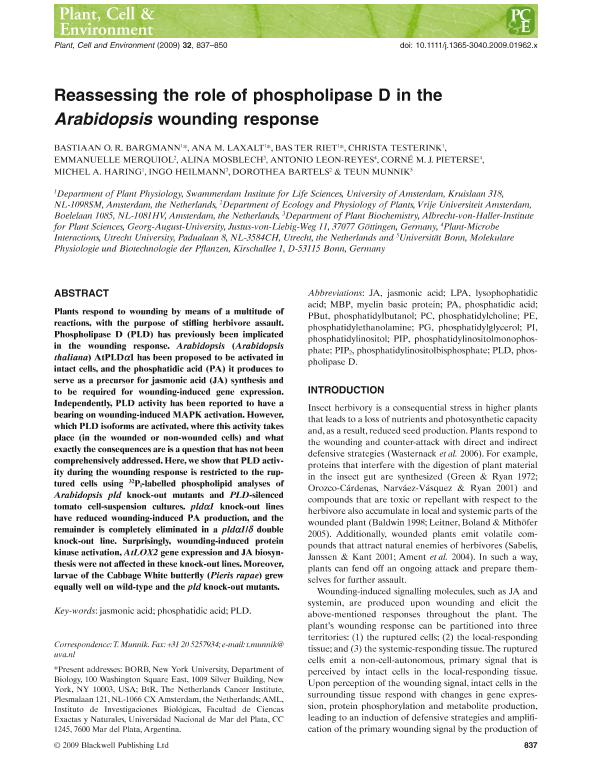
Plants respond to wounding by means of a multitude of reactions, with the purpose of stifling herbivore assault. Phospholipase D (PLD) has previously been implicated in the wounding response. Arabidopsis (Arabidopsis thaliana) AtPLDa1 has been proposed to be activated in intact cells, and the phosphatidic acid (PA) it produces to serve as a precursor for jasmonic acid (JA) synthesis and to be required for wounding-induced gene expression. Independently, PLD activity has been reported to have a bearing on wounding-induced MAPK activation. However, which PLD isoforms are activated, where this activity takes place (in the wounded or non-wounded cells) and what exactly the consequences are is a question that has not been comprehensively addressed. Here, we show that PLD activity during the wounding response is restricted to the ruptured cells using 32Pi-labelled phospholipid analyses of Arabidopsis pld knock-out mutants and PLD-silenced tomato cell-suspension cultures. plda1 knock-out lines have reduced wounding-induced PA production, and the remainder is completely eliminated in a plda1/d double knock-out line. Surprisingly, wounding-induced protein kinase activation, AtLOX2 gene expression and JA biosynthesis were not affected in these knock-out lines. Moreover, larvae of the Cabbage White butterfly (Pieris rapae) grew equally well on wild-type and the pld knock-out mutants.
Palabras clave:
phospholipase D
,
wounding
,
signalling
Archivos asociados

Tamaño:
600.8Kb
Formato:
PDF
Licencia
 Excepto donde se diga explícitamente, este item se publica bajo la siguiente descripción:
Creative Commons Attribution-NonCommercial-ShareAlike 2.5 Unported (CC BY-NC-SA 2.5)
Excepto donde se diga explícitamente, este item se publica bajo la siguiente descripción:
Creative Commons Attribution-NonCommercial-ShareAlike 2.5 Unported (CC BY-NC-SA 2.5)
Identificadores
Colecciones
Articulos(IIB)
Articulos de INSTITUTO DE INVESTIGACIONES BIOLOGICAS
Articulos de INSTITUTO DE INVESTIGACIONES BIOLOGICAS
Citación
Bargmann, Bastiaan O. R.; Laxalt, Ana Maria; Riet, Bas Ter; Testerink, Christa; Merquiol, Emmanuelle; et al.; Reassessing the role of phospholipase D in the Arabidopsis wounding response; Wiley Blackwell Publishing, Inc; Plant, Cell and Environment; 32; 7; 7-2009; 837-850
Compartir


Altmétricas