Artículo
Soil-associated lichens in rangelands of north-eastern Patagonia. Lichen groups and species with potential as bioindicators of grazing disturbance

Fecha de publicación:
11/2004
Editorial:
Cambridge University Press
Revista:
Lichenologist (London)
ISSN:
0024-2829
Idioma:
Inglés
Tipo de recurso:
Artículo publicado
Clasificación temática:
Resumen
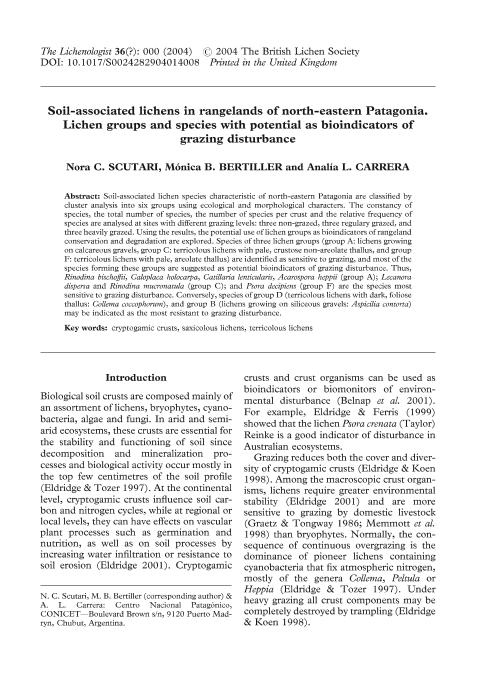
Soil-associated lichen species characteristic of north-eastern Patagonia are classified by cluster analysis into six groups using ecological and morphological characters. The constancy of species, the total number of species, the number of species per crust and the relative frequency of species are analysed at sites with different grazing levels: three non-grazed, three regulary grazed, and three heavily grazed. Using the results, the potential use of lichen groups as bioindicators of rangeland conservation and degradation are explored. Species of three lichen groups (group A: lichens growing on calcareous gravels; group C: terricolous lichens with pale, crustose non-areolate thalli; group F: terricolous lichens with pale, areolate thalli) are identified as sensitive to grazing, and most of the species forming these groups are suggested as potential bioindicators of grazing disturbance. Thus, Rinodina bischoffii, Caloplaca holocarpa, Catillaria lenticularis, Acarospora heppii (group A); Lecanora dispersa and Rinodina mucronatula (group C); and Psora decipiens (group F) are the species most sensitive to grazing disturbance. Conversely, species of group D (terricolous lichens with dark, foliose thallus: Collema coccophorum), and group B (lichens growing on siliceous gravels: Aspicilia contorta) may be indicated as the most resistant to grazing disturbance.
Palabras clave:
CRYPTOGAMIC CRUSTS
,
SAXICOLOUS LICHENS
,
TERRICOLOUS LICHENS
Archivos asociados

Tamaño:
241.9Kb
Formato:
PDF
Licencia
 Excepto donde se diga explícitamente, este item se publica bajo la siguiente descripción:
Creative Commons Attribution-NonCommercial-ShareAlike 2.5 Unported (CC BY-NC-SA 2.5)
Excepto donde se diga explícitamente, este item se publica bajo la siguiente descripción:
Creative Commons Attribution-NonCommercial-ShareAlike 2.5 Unported (CC BY-NC-SA 2.5)
Identificadores
Colecciones
Articulos(CCT-CENPAT)
Articulos de CTRO.CIENTIFICO TECNOL.CONICET - CENPAT
Articulos de CTRO.CIENTIFICO TECNOL.CONICET - CENPAT
Citación
Scutari, Nora Celia; Bertiller, Monica Beatriz; Carrera, Analía Lorena; Soil-associated lichens in rangelands of north-eastern Patagonia. Lichen groups and species with potential as bioindicators of grazing disturbance; Cambridge University Press; Lichenologist (London); 36; 6; 11-2004; 405-412
Compartir


Altmétricas