Artículo
Foraging Behavior and Feeding Locations of Imperial Cormorants and Rock Shags Breeding Sympatrically in Patagonia, Argentina

Fecha de publicación:
12/2003
Editorial:
Waterbird Society
Revista:
Waterbirds
ISSN:
1524-4695
Idioma:
Inglés
Tipo de recurso:
Artículo publicado
Clasificación temática:
Resumen
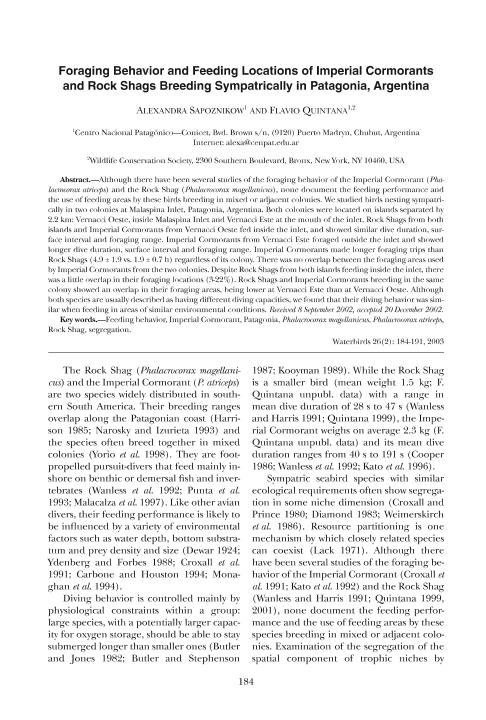
Although there have been several studies of the foraging behavior of the Imperial Cormorant (Phalacrocorax atriceps) and the Rock Shag (Phalacrocorax magellanicus), none document the feeding performance and the use of feeding areas by these birds breeding in mixed or adjacent colonies. We studied birds nesting sympatrically in two colonies at Malaspina Inlet, Patagonia, Argentina. Both colonies were located on islands separated by 2.2 km: Vernacci Oeste, inside Malaspina Inlet and Vernacci Este at the mouth of the inlet. Rock Shags from both islands and Imperial Cormorants from Vernacci Oeste fed inside the inlet, and showed similar dive duration, surface interval and foraging range. Imperial Cormorants from Vernacci Este foraged outside the inlet and showed longer dive duration, surface interval and foraging range. Imperial Cormorants made longer foraging trips than Rock Shags (4.9 ± 1.9 vs. 1.9 ± 0.7 h) regardless of its colony. There was no overlap between the foraging areas used by Imperial Cormorants from the two colonies. Despite Rock Shags from both islands feeding inside the inlet, there was a little overlap in their foraging locations (3-22%). Rock Shags and Imperial Cormorants breeding in the same colony showed an overlap in their foraging areas, being lower at Vernacci Este than at Vernacci Oeste. Although both species are usually described as having different diving capacities, we found that their diving behavior was similar when feeding in areas of similar environmental conditions.
Archivos asociados

Tamaño:
123.7Kb
Formato:
PDF
Licencia
 Excepto donde se diga explícitamente, este item se publica bajo la siguiente descripción:
Creative Commons Attribution-NonCommercial-ShareAlike 2.5 Unported (CC BY-NC-SA 2.5)
Excepto donde se diga explícitamente, este item se publica bajo la siguiente descripción:
Creative Commons Attribution-NonCommercial-ShareAlike 2.5 Unported (CC BY-NC-SA 2.5)
Identificadores
Colecciones
Articulos(CCT-CENPAT)
Articulos de CTRO.CIENTIFICO TECNOL.CONICET - CENPAT
Articulos de CTRO.CIENTIFICO TECNOL.CONICET - CENPAT
Citación
Sapoznikow, Alexandra; Quintana, Flavio Roberto; Foraging Behavior and Feeding Locations of Imperial Cormorants and Rock Shags Breeding Sympatrically in Patagonia, Argentina; Waterbird Society; Waterbirds; 26; 2; 12-2003; 184-191
Compartir


Altmétricas