Artículo
Clinical Presentation of Klinefelter's Syndrome: Differences According to Age
Pacenza, Néstor; Pasqualini, Titania; Gottlieb, Silvia Elisa ; Knoblovits, Pablo; Costanzo, Pablo R.; Stewart Usher, Jorge; Rey, Rodolfo Alberto
; Martínez, María P.; Aszpis, Sergio Mario
; Knoblovits, Pablo; Costanzo, Pablo R.; Stewart Usher, Jorge; Rey, Rodolfo Alberto
; Martínez, María P.; Aszpis, Sergio Mario
; Knoblovits, Pablo; Costanzo, Pablo R.; Stewart Usher, Jorge; Rey, Rodolfo Alberto
; Martínez, María P.; Aszpis, Sergio Mario
Fecha de publicación:
01/2012
Editorial:
Hindawi Publishing Corporation
Revista:
International Journal of Endocrinology
ISSN:
1687-8345
Idioma:
Inglés
Tipo de recurso:
Artículo publicado
Clasificación temática:
Resumen
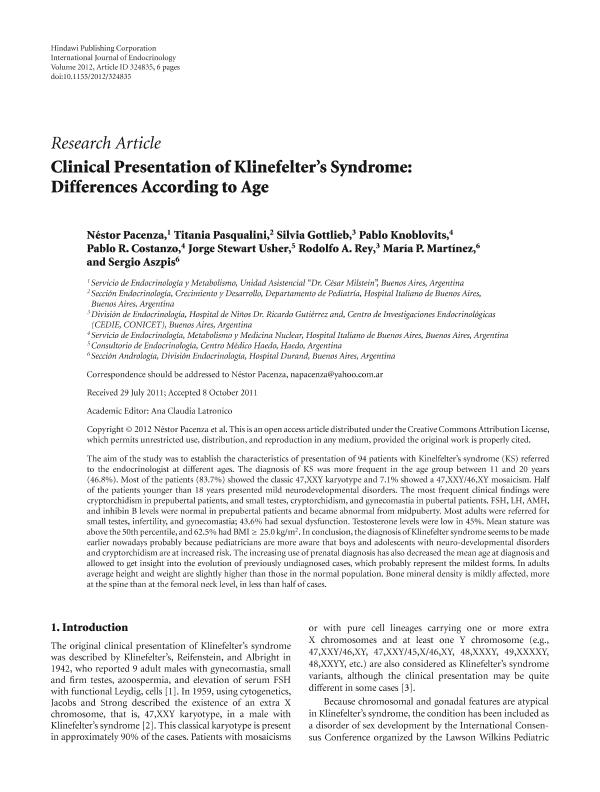
The aim of the study was to establish the characteristics of presentation of 94 patients with Kinelfelter's syndrome (KS) referred to the endocrinologist at different ages. The diagnosis of KS was more frequent in the age group between 11 and 20 years (46.8%). Most of the patients (83.7%) showed the classic 47,XXY karyotype and 7.1% showed a 47,XXY/46,XY mosaicism. Half of the patients younger than 18 years presented mild neurodevelopmental disorders. The most frequent clinical findings were cryptorchidism in prepubertal patients, and small testes, cryptorchidism, and gynecomastia in pubertal patients. FSH, LH, AMH, and inhibin B levels were normal in prepubertal patients and became abnormal from midpuberty. Most adults were referred for small testes, infertility, and gynecomastia; 43.6% had sexual dysfunction. Testosterone levels were low in 45%. Mean stature was above the 50th percentile, and 62.5% had BMI kg/m2. In conclusion, the diagnosis of Klinefelter syndrome seems to be made earlier nowadays probably because pediatricians are more aware that boys and adolescents with neuro-developmental disorders and cryptorchidism are at increased risk. The increasing use of prenatal diagnosis has also decreased the mean age at diagnosis and allowed to get insight into the evolution of previously undiagnosed cases, which probably represent the mildest forms. In adults average height and weight are slightly higher than those in the normal population. Bone mineral density is mildly affected, more at the spine than at the femoral neck level, in less than half of cases.
Palabras clave:
Klinefelter syndrome
,
Hypogonadism
,
testis
,
AMH
Archivos asociados

Tamaño:
576.6Kb
Formato:
PDF
Licencia
 Excepto donde se diga explícitamente, este item se publica bajo la siguiente descripción:
Creative Commons Attribution-NonCommercial-ShareAlike 2.5 Unported (CC BY-NC-SA 2.5)
Excepto donde se diga explícitamente, este item se publica bajo la siguiente descripción:
Creative Commons Attribution-NonCommercial-ShareAlike 2.5 Unported (CC BY-NC-SA 2.5)
Identificadores
Colecciones
Articulos(CEDIE)
Articulos de CENTRO DE INVESTIGACIONES ENDOCRINOLOGICAS "DR. CESAR BERGADA"
Articulos de CENTRO DE INVESTIGACIONES ENDOCRINOLOGICAS "DR. CESAR BERGADA"
Citación
Pacenza, Néstor; Pasqualini, Titania; Gottlieb, Silvia Elisa; Knoblovits, Pablo; Costanzo, Pablo R.; et al.; Clinical Presentation of Klinefelter's Syndrome: Differences According to Age; Hindawi Publishing Corporation ; International Journal of Endocrinology; 2012; 1-2012; 1-6
Compartir


Altmétricas