Artículo
Effects of the sorption/desorption process on the fluoranthene degradation by wild strains of Hansenula angusta and Rhodotorula minuta

Fecha de publicación:
08/2011
Editorial:
International Research Journals
Revista:
International Research Journal of Microbiology
ISSN:
2141-5463
Idioma:
Inglés
Tipo de recurso:
Artículo publicado
Clasificación temática:
Resumen
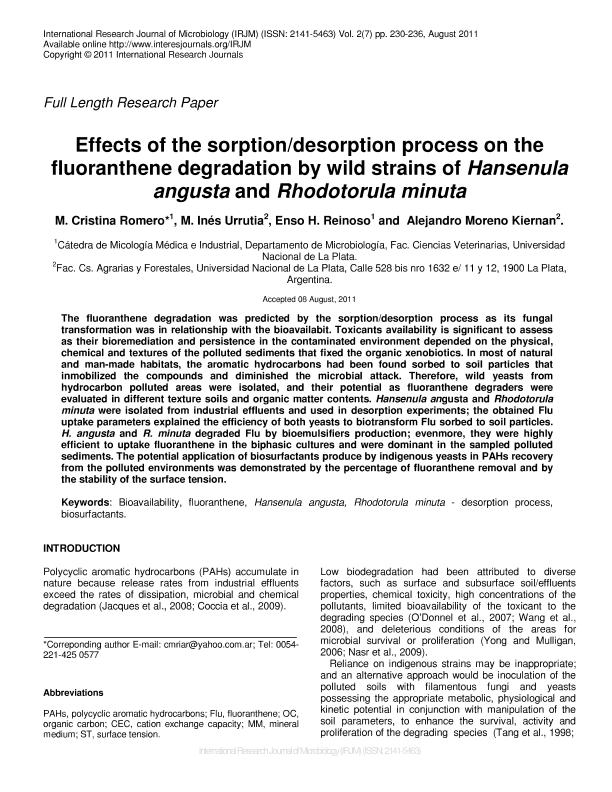
The fluoranthene degradation was predicted by the sorption/desorption process as its fungal transformation was in relationship with the bioavailabit. Toxicants availability is significant to assess as their bioremediation and persistence in the contaminated environment depended on the physical, chemical and textures of the polluted sediments that fixed the organic xenobiotics. In most of natural and man-made habitats, the aromatic hydrocarbons had been found sorbed to soil particles that inmobilized the compounds and diminished the microbial attack. Therefore, wild yeasts from hydrocarbon polluted areas were isolated, and their potential as fluoranthene degraders were evaluated in different texture soils and organic matter contents. Hansenula angusta and Rhodotorula minuta were isolated from industrial effluents and used in desorption experiments; the obtained Flu uptake parameters explained the efficiency of both yeasts to biotransform Flu sorbed to soil particles. H. angusta and R. minuta degraded Flu by bioemulsifiers production; evenmore, they were highly efficient to uptake fluoranthene in the biphasic cultures and were dominant in the sampled polluted sediments. The potential application of biosurfactants produce by indigenous yeasts in PAHs recovery from the polluted environments was demonstrated by the percentage of fluoranthene removal and by the stability of the surface tension.
Archivos asociados

Tamaño:
132.5Kb
Formato:
PDF
Licencia
 Excepto donde se diga explícitamente, este item se publica bajo la siguiente descripción:
Creative Commons Attribution-NonCommercial-ShareAlike 2.5 Unported (CC BY-NC-SA 2.5)
Excepto donde se diga explícitamente, este item se publica bajo la siguiente descripción:
Creative Commons Attribution-NonCommercial-ShareAlike 2.5 Unported (CC BY-NC-SA 2.5)
Identificadores
Colecciones
Articulos(CCT - LA PLATA)
Articulos de CTRO.CIENTIFICO TECNOL.CONICET - LA PLATA
Articulos de CTRO.CIENTIFICO TECNOL.CONICET - LA PLATA
Citación
Romero, Maria Cristina; Urrutia, María Inés; Reinoso, Enso H.; Moreno Kiernan, Alejandro Ricardo; Effects of the sorption/desorption process on the fluoranthene degradation by wild strains of Hansenula angusta and Rhodotorula minuta; International Research Journals; International Research Journal of Microbiology; 2; 7; 8-2011; 230-236
Compartir

