Artículo
Ev cysts of Physaloptera sp. (Nematodes) in stomachs of Physalaemus biligonigerus (Anura: Leptodactylidae) populations that inhabit transgenic soybean cultivated areas of Córdoba province (Argentina).
Attademo, Andres Maximiliano ; Gutierrez, Cesar; Guerrero, Sergio; Peltzer, Paola
; Lajmanovich, Rafael Carlos
; Gutierrez, Cesar; Guerrero, Sergio; Peltzer, Paola
; Lajmanovich, Rafael Carlos
; Gutierrez, Cesar; Guerrero, Sergio; Peltzer, Paola
; Lajmanovich, Rafael Carlos
Fecha de publicación:
12/2005
Editorial:
Society for the Study of Amphibian and Reptiles
Revista:
Herpetological Review
ISSN:
0018-084X
Idioma:
Inglés
Tipo de recurso:
Artículo publicado
Clasificación temática:
Resumen
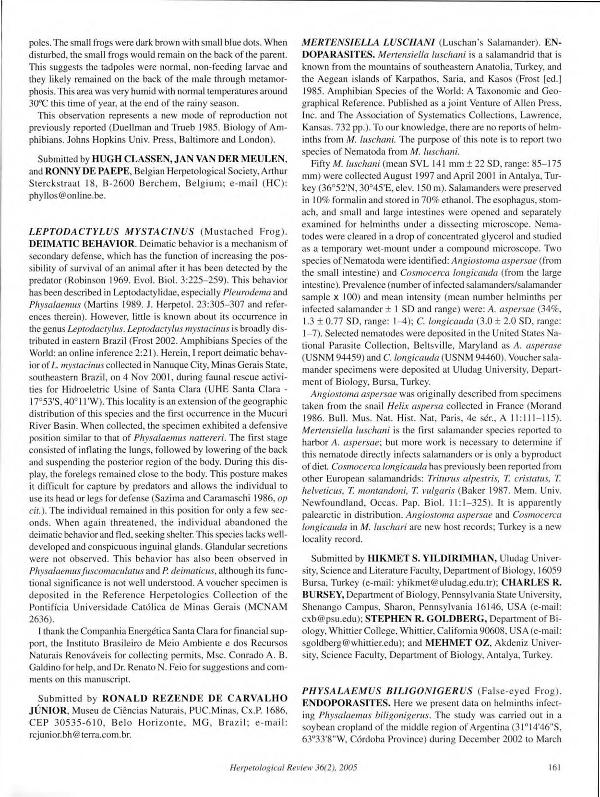
Here we present data on helminths infecting the false-eyed frog Physalaemus biligonigerus (Anura, Leptodactylidae). The study took place in a soybean cropland of middle region of Argentina carried out in December 2002 to March 2003. We collected 19 adult P. biligonigerus. A hundred (100 %) frogs were infected by helminths. The number of helminth species per individual host varied from one to three (most frequently three) and was not related to frog snout-vent length measurements. Three helminth species were recovered from the P. biligonigerus: one acanthocephalan, Echinorhynchidae (Acantocephalus lutzi), and two nematodes (Rhabdias sp., and Physaloptera sp.; the latter found only as larvae cysts). Physalaemus biligonigerus represents a new host record for Acanthocephalus lutzi and the genus Physaloptera and Rhabdias. Although the small sample sizes, our data suggest that the population of P. biligonigerus that inhabited soybean cropland have a relatively high frequency of helminth infection, with the nematode Physaloptera being the most prevalent among them. Stress in the form of pesticide exposure decreased the host amphibians’ ability to resist infection, resulting in higher parasite loads. In addition the anurans are exposed to a mix of pesticide to reduce insect, weed, and disease pests of those crops. However, further studies are necessary to validate this hypothesis and to confirm the relationship between pesticide exposure and the parasite infection.
Palabras clave:
Physalaemus biligonigerus
Archivos asociados

Tamaño:
624.8Kb
Formato:
PDF
Licencia
 Excepto donde se diga explícitamente, este item se publica bajo la siguiente descripción:
Creative Commons Attribution-NonCommercial-ShareAlike 2.5 Unported (CC BY-NC-SA 2.5)
Excepto donde se diga explícitamente, este item se publica bajo la siguiente descripción:
Creative Commons Attribution-NonCommercial-ShareAlike 2.5 Unported (CC BY-NC-SA 2.5)
Identificadores
Colecciones
Articulos(CCT - SANTA FE)
Articulos de CTRO.CIENTIFICO TECNOL.CONICET - SANTA FE
Articulos de CTRO.CIENTIFICO TECNOL.CONICET - SANTA FE
Citación
Attademo, Andres Maximiliano; Gutierrez, Cesar; Guerrero, Sergio; Peltzer, Paola; Lajmanovich, Rafael Carlos; Ev cysts of Physaloptera sp. (Nematodes) in stomachs of Physalaemus biligonigerus (Anura: Leptodactylidae) populations that inhabit transgenic soybean cultivated areas of Córdoba province (Argentina).; Society for the Study of Amphibian and Reptiles; Herpetological Review; 36; 12-2005; 161-162
Compartir

