Mostrar el registro sencillo del ítem
dc.contributor.author
García, Elina V.
dc.contributor.author
Oliva, Maria E.
dc.contributor.author
Leblanc, Jean Guy Joseph
dc.contributor.author
Barrera, Antonio Daniel
dc.date.available
2020-04-02T18:33:51Z
dc.date.issued
2018-10
dc.identifier.citation
García, Elina V.; Oliva, Maria E.; Leblanc, Jean Guy Joseph; Barrera, Antonio Daniel; Epi-nutrients in the oviductal environment: Folate levels and differential gene expression of its receptors and transporters in the bovine oviduct; Elsevier; Theriogenology; 119; 10-2018; 189-197
dc.identifier.issn
0093-691X
dc.identifier.uri
http://hdl.handle.net/11336/101683
dc.description.abstract
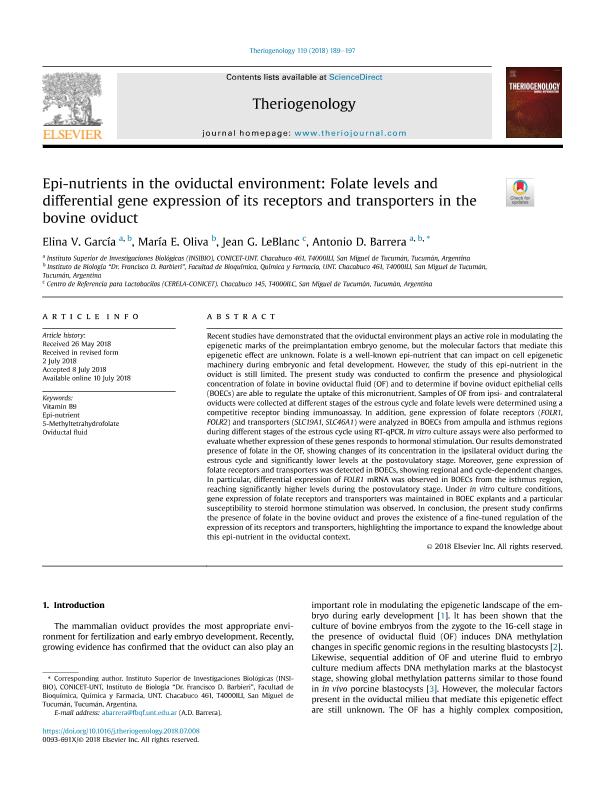
Recent studies have demonstrated that the oviductal environment plays an active role in modulating the epigenetic marks of the preimplantation embryo genome, but the molecular factors that mediate this epigenetic effect are unknown. Folate is a well-known epi-nutrient that can impact on cell epigenetic machinery during embryonic and fetal development. However, the study of this epi-nutrient in the oviduct is still limited. The present study was conducted to confirm the presence and physiological concentration of folate in bovine oviductal fluid (OF) and to determine if bovine oviduct epithelial cells (BOECs) are able to regulate the uptake of this micronutrient. Samples of OF from ipsi- and contralateral oviducts were collected at different stages of the estrous cycle and folate levels were determined using a competitive receptor binding immunoassay. In addition, gene expression of folate receptors (FOLR1, FOLR2) and transporters (SLC19A1, SLC46A1) were analyzed in BOECs from ampulla and isthmus regions during different stages of the estrous cycle using RT-qPCR. In vitro culture assays were also performed to evaluate whether expression of these genes responds to hormonal stimulation. Our results demonstrated presence of folate in the OF, showing changes of its concentration in the ipsilateral oviduct during the estrous cycle and significantly lower levels at the postovulatory stage. Moreover, gene expression of folate receptors and transporters was detected in BOECs, showing regional and cycle-dependent changes. In particular, differential expression of FOLR1 mRNA was observed in BOECs from the isthmus region, reaching significantly higher levels during the postovulatory stage. Under in vitro culture conditions, gene expression of folate receptors and transporters was maintained in BOEC explants and a particular susceptibility to steroid hormone stimulation was observed. In conclusion, the present study confirms the presence of folate in the bovine oviduct and proves the existence of a fine-tuned regulation of the expression of its receptors and transporters, highlighting the importance to expand the knowledge about this epi-nutrient in the oviductal context.
dc.format
application/pdf
dc.language.iso
eng
dc.publisher
Elsevier
dc.rights
info:eu-repo/semantics/openAccess
dc.rights.uri
https://creativecommons.org/licenses/by-nc-sa/2.5/ar/
dc.subject
5-METHYLTETRAHYDROFOLATE
dc.subject
EPI-NUTRIENT
dc.subject
OVIDUCTAL FLUID
dc.subject
VITAMIN B9
dc.subject.classification
Biología Reproductiva
dc.subject.classification
Ciencias Biológicas
dc.subject.classification
CIENCIAS NATURALES Y EXACTAS
dc.title
Epi-nutrients in the oviductal environment: Folate levels and differential gene expression of its receptors and transporters in the bovine oviduct
dc.type
info:eu-repo/semantics/article
dc.type
info:ar-repo/semantics/artículo
dc.type
info:eu-repo/semantics/publishedVersion
dc.date.updated
2019-07-24T18:04:04Z
dc.identifier.eissn
1879-3231
dc.journal.volume
119
dc.journal.pagination
189-197
dc.journal.pais
Estados Unidos
dc.journal.ciudad
Los Altos
dc.description.fil
Fil: García, Elina V.. Consejo Nacional de Investigaciones Científicas y Técnicas. Centro Científico Tecnológico Conicet - Tucumán. Instituto Superior de Investigaciones Biológicas. Universidad Nacional de Tucumán. Instituto Superior de Investigaciones Biológicas; Argentina. Universidad Nacional de Tucumán; Argentina
dc.description.fil
Fil: Oliva, María E.. Consejo Nacional de Investigaciones Científicas y Técnicas. Centro Científico Tecnológico Conicet - Tucumán. Instituto Superior de Investigaciones Biológicas. Universidad Nacional de Tucumán. Instituto Superior de Investigaciones Biológicas; Argentina
dc.description.fil
Fil: Leblanc, Jean Guy Joseph. Consejo Nacional de Investigaciones Científicas y Técnicas. Centro Científico Tecnológico Conicet - Tucumán. Centro de Referencia para Lactobacilos; Argentina
dc.description.fil
Fil: Barrera, Antonio Daniel. Consejo Nacional de Investigaciones Científicas y Técnicas. Centro Científico Tecnológico Conicet - Tucumán. Centro de Referencia para Lactobacilos; Argentina
dc.journal.title
Theriogenology
dc.relation.alternativeid
info:eu-repo/semantics/altIdentifier/doi/https://doi.org/10.1016/j.theriogenology.2018.07.008
dc.relation.alternativeid
info:eu-repo/semantics/altIdentifier/url/https://www.sciencedirect.com/science/article/abs/pii/S0093691X18302619
Archivos asociados

Tamaño:
911.5Kb
Formato:
PDF