Artículo
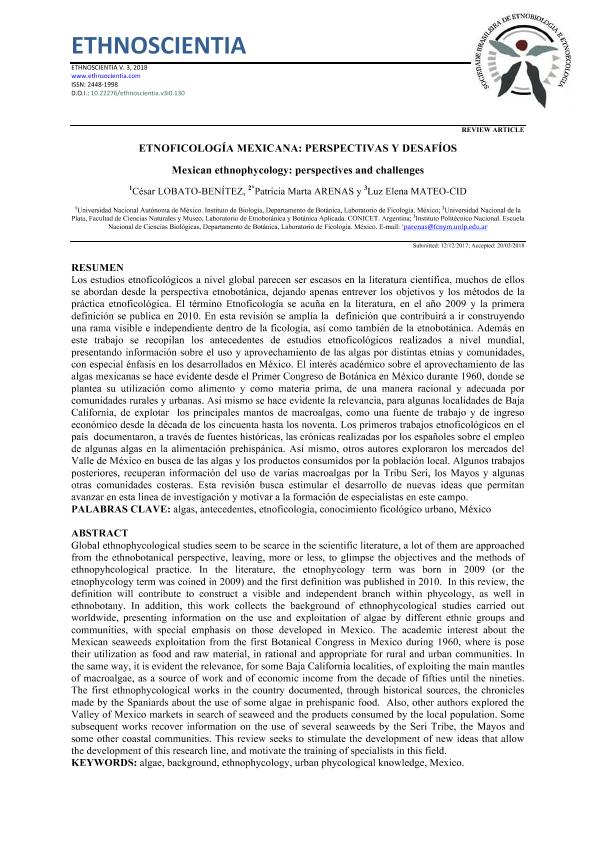
Los estudios etnoficológicos a nivel global parecen ser escasos en la literatura científica, muchos de ellos se abordan desde la perspectiva etnobotánica, dejando apenas entrever los objetivos y los métodos de la práctica etnoficológica. El término Etnoficología se acuña en la literatura, en el año 2009 y la primera definición se publica en 2010. En esta revisión se amplía la definición que contribuirá a ir construyendo una rama visible e independiente dentro de la ficología, así como también de la etnobotánica. Además en este trabajo se recopilan los antecedentes de estudios etnoficológicos realizados a nivel mundial, presentando información sobre el uso y aprovechamiento de las algas por distintas etnias y comunidades, con especial énfasis en los desarrollados en México. El interés académico sobre el aprovechamiento de las algas mexicanas se hace evidente desde el Primer Congreso de Botánica en México durante 1960, donde se plantea su utilización como alimento y como materia prima, de una manera racional y adecuada por comunidades rurales y urbanas. Así mismo se hace evidente la relevancia, para algunas localidades de Baja California, de explotar los principales mantos de macroalgas, como una fuente de trabajo y de ingreso económico desde la década de los cincuenta hasta los noventa. Los primeros trabajos etnoficológicos en el país documentaron, a través de fuentes históricas, las crónicas realizadas por los españoles sobre el empleo de algunas algas en la alimentación prehispánica. Así mismo, otros autores exploraron los mercados del Valle de México en busca de las algas y los productos consumidos por la población local. Algunos trabajos posteriores, recuperan información del uso de varias macroalgas por la Tribu Seri, los Mayos y algunas otras comunidades costeras. Esta revisión busca estimular el desarrollo de nuevas ideas que permitan avanzar en esta línea de investigación y motivar a la formación de especialistas en este campo. Global ethnophycological studies seem to be scarce in the scientific literature, a lot of them are approachedfrom the ethnobotanical perspective, leaving, more or less, to glimpse the objectives and the methods ofethnopyhcological practice. In the literature, the etnophycology term was born in 2009 (or theetnophycology term was coined in 2009) and the first definition was published in 2010. In this review, thedefinition will contribute to construct a visible and independent branch within phycology, as well inethnobotany. In addition, this work collects the background of ethnophycological studies carried outworldwide, presenting information on the use and exploitation of algae by different ethnic groups andcommunities, with special emphasis on those developed in Mexico. The academic interest about theMexican seaweeds exploitation from the first Botanical Congress in Mexico during 1960, where is posetheir utilization as food and raw material, in rational and appropriate for rural and urban communities. Inthe same way, it is evident the relevance, for some Baja California localities, of exploiting the main mantlesof macroalgae, as a source of work and of economic income from the decade of fifties until the nineties.The first ethnophycological works in the country documented, through historical sources, the chroniclesmade by the Spaniards about the use of some algae in prehispanic food. Also, other authors explored theValley of Mexico markets in search of seaweed and the products consumed by the local population. Somesubsequent works recover information on the use of several seaweeds by the Seri Tribe, the Mayos andsome other coastal communities. This review seeks to stimulate the development of new ideas that allowthe development of this research line, and motivate the training of specialists in this field.
Etnoficología Mexicana: perspectivas y desafíos
Título:
Mexican ethnophycology: perspectives and challenges

Fecha de publicación:
03/2018
Editorial:
Sociedade Brasileira de Etnobiologia e Etnoecologia
Revista:
Ethnoscientia
ISSN:
2448-1998
Idioma:
Español
Tipo de recurso:
Artículo publicado
Clasificación temática:
Resumen
Palabras clave:
algas
,
etnoficología
,
conocimiento ficológico urbano
,
México
Archivos asociados

Tamaño:
293.5Kb
Formato:
PDF
Licencia
 Excepto donde se diga explícitamente, este item se publica bajo la siguiente descripción:
Creative Commons Attribution 2.5 Unported (CC BY 2.5)
Excepto donde se diga explícitamente, este item se publica bajo la siguiente descripción:
Creative Commons Attribution 2.5 Unported (CC BY 2.5)
Identificadores
Colecciones
Articulos(CCT - LA PLATA)
Articulos de CTRO.CIENTIFICO TECNOL.CONICET - LA PLATA
Articulos de CTRO.CIENTIFICO TECNOL.CONICET - LA PLATA
Citación
Lobato Benítez, César; Arenas, Patricia Marta; Mateo Cid, Luz Elena; Etnoficología Mexicana: perspectivas y desafíos; Sociedade Brasileira de Etnobiologia e Etnoecologia; Ethnoscientia; 3; 3-2018; 1-16
Compartir


Altmétricas