Artículo
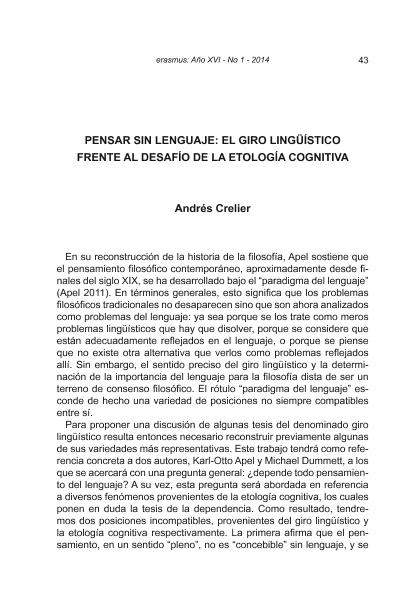
El objetivo del trabajo es hacer compatibles el giro lingüístico y la reciente etología cognitiva. Para ello, ofrezco primero una reconstrucción de dos variedades del giro lingüístico, la de Apel y Dummett, según las cuales el pensamiento depende del lenguaje. Expongo luego algunos fenómenos de la etología cognitiva que suponen un cuestionamiento de esa dependencia. Analizo entonces algunas tesis más flexibles ofrecidas en el marco del giro lingüístico y señalo sus insuficiencias, en tanto siguen requiriendo la presencia de un trasfondo lingüístico actual. Intento luego delinear un principio de expresabilidad que logre la compatibilidad buscada, y me aproximo finalmente al problema pendiente del carácter público del significado. This paper presents a reconstruction of two variants of the linguistic turn (Apel and Dummett ), and discusses some cognitive ethology phenomena that pose a challenge to the thesis of dependence of thought on language, focusing on the idea that all meaningful thought is virtually expressed through language. The failure of the latter thesis and the way to overcome it is then explained. Finally, the problem of the public nature of meaning is presented. Der Artikel stellt eine Rekonstruktion von zwei Varianten des linguistic turn (Apel und Dummett) vor, und diskutiert einige Phänomene der kognitiven Ethologie, die die These der Abhängigkeit des Denkens von der Sprache in Frage stellen. Dabei konzentriert er sich auf die Idee, dass alles sinnvolle Denken virtuell durch die Sprache ausdrückbar ist. Daraufhin wird die Unzulänglichkeit der letzteren These aufgezeigt, sowie die Art und Weise, wie man diese überwinden könnte. Schließlich wird das Problem der Öffentlichkeit jeglicher Bedeutung aufgeworfen.
Pensar sin lenguaje : el giro lingüístico frente al desafío de la etología cognitiva

Fecha de publicación:
01/2014
Editorial:
Fundación Intercambio Cultural Alemán-Latinoamericano
Revista:
Erasmus
ISSN:
1514-6049
Idioma:
Español
Tipo de recurso:
Artículo publicado
Clasificación temática:
Resumen
Archivos asociados

Tamaño:
426.3Kb
Formato:
PDF
Licencia
 Excepto donde se diga explícitamente, este item se publica bajo la siguiente descripción:
Creative Commons Attribution-NonCommercial-ShareAlike 2.5 Unported (CC BY-NC-SA 2.5)
Excepto donde se diga explícitamente, este item se publica bajo la siguiente descripción:
Creative Commons Attribution-NonCommercial-ShareAlike 2.5 Unported (CC BY-NC-SA 2.5)
Identificadores
Colecciones
Articulos(CCT - MAR DEL PLATA)
Articulos de CTRO.CIENTIFICO TECNOL.CONICET - MAR DEL PLATA
Articulos de CTRO.CIENTIFICO TECNOL.CONICET - MAR DEL PLATA
Citación
Crelier, Pablo Andres; Pensar sin lenguaje : el giro lingüístico frente al desafío de la etología cognitiva; Fundación Intercambio Cultural Alemán-Latinoamericano; Erasmus; 16; 1; 1-2014; 43-59
Compartir

