Artículo
Biodegradation of polycyclic aromatic hydrocarbons (PAHs) by fungal enzymes: A review
Kadri, Tayssir; Rouissi, Tarek; Brar, Satinder Kaur; Cledón, Maximiliano ; Sarma, Saurabhjyoti; Verma, Mausam
; Sarma, Saurabhjyoti; Verma, Mausam
Fecha de publicación:
01/2017
Editorial:
Science Press
Revista:
Journal of Environmental Sciences
ISSN:
1001-0742
Idioma:
Inglés
Tipo de recurso:
Artículo publicado
Clasificación temática:
Resumen
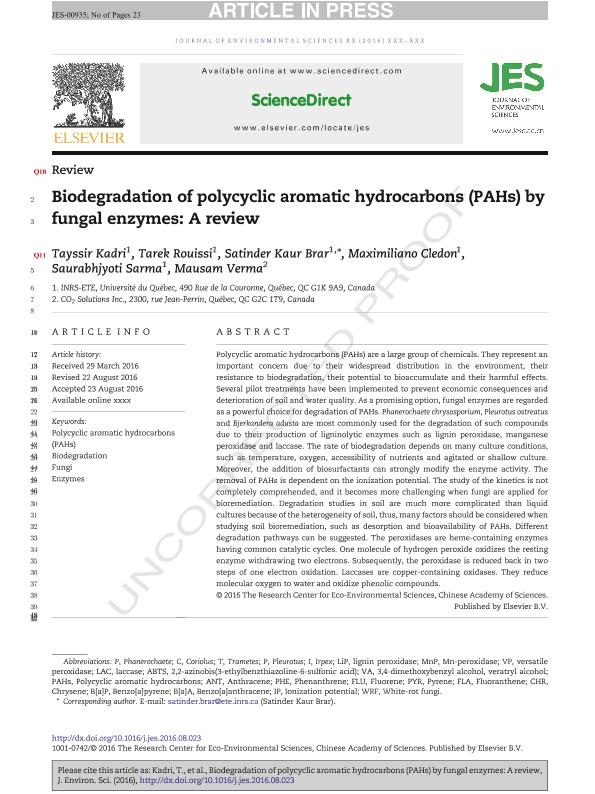
Polycyclic aromatic hydrocarbons (PAHs) are a large group of chemicals. They represent an important concern due to their widespread distribution in the environment, their resistance to biodegradation, their potential to bioaccumulate and their harmful effects. Several pilot treatments have been implemented to prevent economic consequences and deterioration of soil and water quality. As a promising option, fungal enzymes are regarded as a powerful choice for degradation of PAHs. Phanerochaete chrysosporium, Pleurotus ostreatus and Bjerkandera adusta are most commonly used for the degradation of such compounds due to their production of ligninolytic enzymes such as lignin peroxidase, manganese peroxidase and laccase. The rate of biodegradation depends on many culture conditions, such as temperature, oxygen, accessibility of nutrients and agitated or shallow culture. Moreover, the addition of biosurfactants can strongly modify the enzyme activity. The removal of PAHs is dependent on the ionization potential. The study of the kinetics is not completely comprehended, and it becomes more challenging when fungi are applied for bioremediation. Degradation studies in soil are much more complicated than liquid cultures because of the heterogeneity of soil, thus, many factors should be considered when studying soil bioremediation, such as desorption and bioavailability of PAHs. Different degradation pathways can be suggested. The peroxidases are heme-containing enzymes having common catalytic cycles. One molecule of hydrogen peroxide oxidizes the resting enzyme withdrawing two electrons. Subsequently, the peroxidase is reduced back in two steps of one electron oxidation. Laccases are copper-containing oxidases. They reduce molecular oxygen to water and oxidize phenolic compounds.
Palabras clave:
BIODEGRADATION
,
ENZYMES
,
FUNGI
,
POLYCYCLIC AROMATIC HYDROCARBONS (PAHS)
Archivos asociados

Tamaño:
1.083Mb
Formato:
PDF
Licencia
 Excepto donde se diga explícitamente, este item se publica bajo la siguiente descripción:
Creative Commons Attribution-NonCommercial-ShareAlike 2.5 Unported (CC BY-NC-SA 2.5)
Excepto donde se diga explícitamente, este item se publica bajo la siguiente descripción:
Creative Commons Attribution-NonCommercial-ShareAlike 2.5 Unported (CC BY-NC-SA 2.5)
Identificadores
Colecciones
Articulos(IIMYC)
Articulos de INSTITUTO DE INVESTIGACIONES MARINAS Y COSTERAS
Articulos de INSTITUTO DE INVESTIGACIONES MARINAS Y COSTERAS
Citación
Kadri, Tayssir; Rouissi, Tarek; Brar, Satinder Kaur; Cledón, Maximiliano; Sarma, Saurabhjyoti; et al.; Biodegradation of polycyclic aromatic hydrocarbons (PAHs) by fungal enzymes: A review; Science Press; Journal of Environmental Sciences; 51; 1-2017; 52-74
Compartir


Altmétricas