Artículo
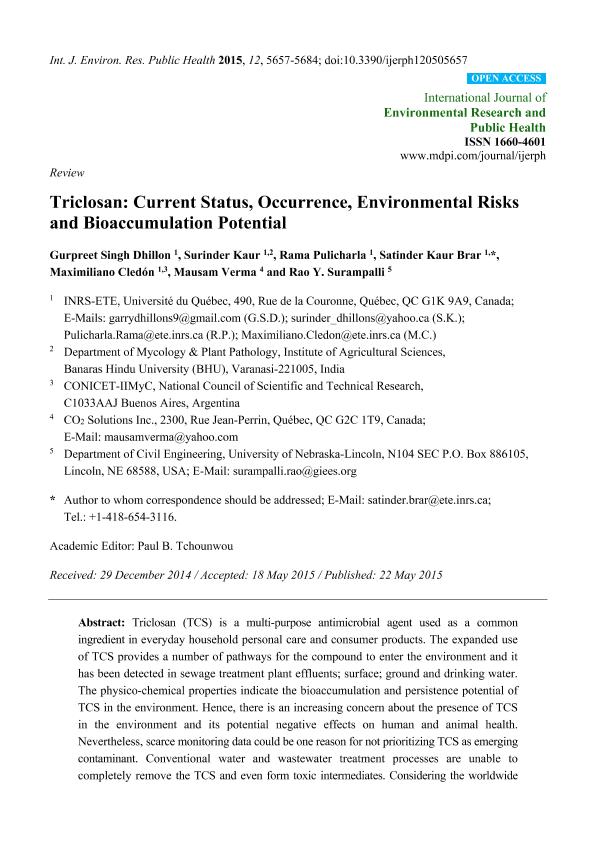
Triclosan: Current status, occurrence, environmental risks and bioaccumulation potential
Dhillon, Gurpreet Singh; Kaur, Surinder; Pulicharla, Rama; Brar, Satinder Kaur; Cledón, Maximiliano ; Verma, Mausam; Surampalli, Rao Y.
; Verma, Mausam; Surampalli, Rao Y.
Fecha de publicación:
05/2015
Editorial:
Molecular Diversity Preservation International
Revista:
International Journal of Environmental Research and Public Health
ISSN:
1660-4601
Idioma:
Inglés
Tipo de recurso:
Artículo publicado
Clasificación temática:
Resumen
Triclosan (TCS) is a multi-purpose antimicrobial agent used as a common ingredient in everyday household personal care and consumer products. The expanded use of TCS provides a number of pathways for the compound to enter the environment and it has been detected in sewage treatment plant effluents; surface; ground and drinking water. The physico-chemical properties indicate the bioaccumulation and persistence potential of TCS in the environment. Hence, there is an increasing concern about the presence of TCS in the environment and its potential negative effects on human and animal health. Nevertheless, scarce monitoring data could be one reason for not prioritizing TCS as emerging contaminant. Conventional water and wastewater treatment processes are unable to completely remove the TCS and even form toxic intermediates. Considering the worldwide application of personal care products containing TCS and inefficient removal and its toxic effects on aquatic organisms, the compound should be considered on the priority list of emerging contaminants and its utilization in all products should be regulated.
Archivos asociados

Tamaño:
2.088Mb
Formato:
PDF
Licencia
 Excepto donde se diga explícitamente, este item se publica bajo la siguiente descripción:
Creative Commons Attribution-NonCommercial-ShareAlike 2.5 Unported (CC BY-NC-SA 2.5)
Excepto donde se diga explícitamente, este item se publica bajo la siguiente descripción:
Creative Commons Attribution-NonCommercial-ShareAlike 2.5 Unported (CC BY-NC-SA 2.5)
Identificadores
Colecciones
Articulos(IIMYC)
Articulos de INSTITUTO DE INVESTIGACIONES MARINAS Y COSTERAS
Articulos de INSTITUTO DE INVESTIGACIONES MARINAS Y COSTERAS
Citación
Dhillon, Gurpreet Singh; Kaur, Surinder; Pulicharla, Rama; Brar, Satinder Kaur; Cledón, Maximiliano; et al.; Triclosan: Current status, occurrence, environmental risks and bioaccumulation potential; Molecular Diversity Preservation International; International Journal of Environmental Research and Public Health; 12; 5; 5-2015; 5657-5684
Compartir


Altmétricas