Mostrar el registro sencillo del ítem
dc.contributor.author
Quiroga, Maria Virginia
dc.date.available
2020-03-20T22:31:45Z
dc.date.issued
2018-10
dc.identifier.citation
Quiroga, Maria Virginia; Tradiciones políticas y hegemonía. Hacia lo plurinacional-popular en Bolivia; Universidad Nacional Autónoma de México; Latinoamérica. Revista de Estudios Latinoamericanos; 2; 67; 10-2018; 1-25
dc.identifier.issn
2448-6914
dc.identifier.uri
http://hdl.handle.net/11336/100565
dc.description.abstract
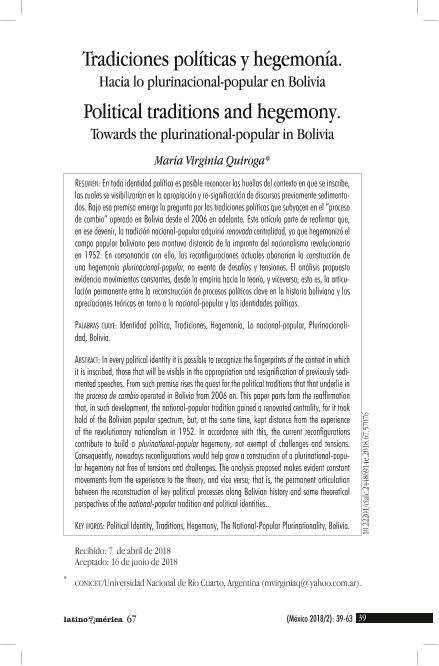
En toda identidad política es posible reconocer las huellas del contexto en que se inscribe, las cuales se visibilizarían en la apropiación y re-significación de discursos previamente sedimentados. Bajo esa premisa emerge la pregunta por las tradiciones políticas que subyacen en el "proceso de cambio" operado en Bolivia desde el 2006 en adelante. Este artículo parte de reafirmar que, en ese devenir, la tradición nacional-popular adquirió renovada centralidad, ya que hegemonizó el campo popular boliviano pero mantuvo distancia de la impronta del nacionalismo revolucionario en 1952. En consonancia con ello, las reconfiguraciones actuales abonarían la construcción de una hegemonía plurinacional-popular, no exenta de desafíos y tensiones. El análisis propuesto evidencia movimientos constantes, desde la empiria hacia la teoría, y viceversa; esto es, la articulación permanente entre la reconstrucción de procesos políticos clave en la historia boliviana y las apreciaciones teóricas en torno a lo nacional-popular y las identidades políticas.
dc.description.abstract
: In every political identity it is possible to recognize the fingerprints of the context in which it is inscribed, those that will be visible in the appropriation and resignification of previously sedimented speeches. From such premise rises the quest for the political traditions that that underlie in the proceso de cambio operated in Bolivia from 2006 on. This paper parts form the reaffirmation that, in such development, the national-popular tradition gained a renovated centrality, for it took hold of the Bolivian popular spectrum, but, at the same time, kept distance from the experience of the revolutionary nationalism in 1952. In accordance with this, the current reconfigurations contribute to build a plurinational-popular hegemony, not exempt of challenges and tensions. Consequently, nowadays reconfigurations would help grow a construction of a plurinational-popular hegemony not free of tensions and challenges. The analysis proposed makes evident constant movements from the experience to the theory, and vice versa; that is, the permanent articulation between the reconstruction of key political processes along Bolivian history and some theoretical perspectives of the national-popular tradition and political identities.
dc.format
application/pdf
dc.language.iso
spa
dc.publisher
Universidad Nacional Autónoma de México
dc.rights
info:eu-repo/semantics/openAccess
dc.rights.uri
https://creativecommons.org/licenses/by-nc-sa/2.5/ar/
dc.subject
IDENTIDAD POLITICA
dc.subject
TRADICIONES
dc.subject
NACIONAL-POPULAR
dc.subject
BOLIVIA
dc.subject.classification
Ciencia Política
dc.subject.classification
Ciencia Política
dc.subject.classification
CIENCIAS SOCIALES
dc.title
Tradiciones políticas y hegemonía. Hacia lo plurinacional-popular en Bolivia
dc.title
Political traditions and hegemony. Towards the plurinational-popular in Bolivia
dc.type
info:eu-repo/semantics/article
dc.type
info:ar-repo/semantics/artículo
dc.type
info:eu-repo/semantics/publishedVersion
dc.date.updated
2020-03-13T18:10:49Z
dc.journal.volume
2
dc.journal.number
67
dc.journal.pagination
1-25
dc.journal.pais
México
dc.journal.ciudad
Mexico
dc.description.fil
Fil: Quiroga, Maria Virginia. Consejo Nacional de Investigaciones Científicas y Técnicas; Argentina. Universidad Nacional de Río Cuarto. Facultad de Ciencias Humanas. Departamento de Historia. Centro de Investigaciones Históricas; Argentina
dc.journal.title
Latinoamérica. Revista de Estudios Latinoamericanos
dc.relation.alternativeid
info:eu-repo/semantics/altIdentifier/url/http://ref.scielo.org/dkfynm
dc.relation.alternativeid
info:eu-repo/semantics/altIdentifier/doi/http://dx.doi.org/10.22201/cialc.24486914e.2018.67.57076
Archivos asociados

Tamaño:
605.9Kb
Formato:
PDF