Artículo
Bumblebees learn foraging routes through exploitation-exploration cycles
Kembro, Jackelyn Melissa ; Lihoreau, Mathieu; Garriga, Joan; Raposo, Ernesto P.; Bartumeus, Frederic
; Lihoreau, Mathieu; Garriga, Joan; Raposo, Ernesto P.; Bartumeus, Frederic
Fecha de publicación:
10/07/2019
Editorial:
The Royal Society
Revista:
Journal of the Royal Society Interface
ISSN:
1742-5689
e-ISSN:
1742-5662
Idioma:
Inglés
Tipo de recurso:
Artículo publicado
Clasificación temática:
Resumen
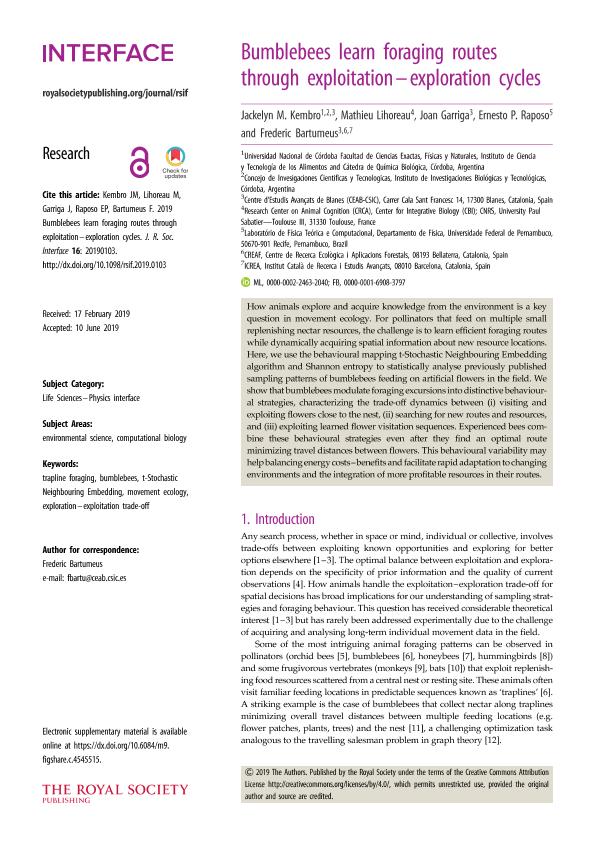
How animals explore and acquire knowledge from the environment is a key question in movement ecology. For pollinators that feed on multiple small replenishing nectar resources, the challenge is to learn efficient foraging routes while dynamically acquiring spatial information about new resource locations. Here, we use the behavioural mapping t-Stochastic Neighbouring Embedding algorithm and Shannon entropy to statistically analyse previously published sampling patterns of bumblebees feeding on artificial flowers in the field. We showthat bumblebeesmodulate foraging excursions into distinctive behavioural strategies, characterizing the trade-off dynamics between (i) visiting and exploiting flowers close to the nest, (ii) searching for new routes and resources, and (iii) exploiting learned flower visitation sequences. Experienced bees combine these behavioural strategies even after they find an optimal route minimizing travel distances between flowers. This behavioural variability may help balancing energycosts-benefits and facilitate rapidadaptationto changing environments and the integration of more profitable resources in their routes.
Archivos asociados

Tamaño:
1.039Mb
Formato:
PDF
Licencia
 Excepto donde se diga explícitamente, este item se publica bajo la siguiente descripción:
Creative Commons Attribution-NonCommercial-ShareAlike 2.5 Unported (CC BY-NC-SA 2.5)
Excepto donde se diga explícitamente, este item se publica bajo la siguiente descripción:
Creative Commons Attribution-NonCommercial-ShareAlike 2.5 Unported (CC BY-NC-SA 2.5)
Identificadores
Colecciones
Articulos(IIBYT)
Articulos de INSTITUTO DE INVESTIGACIONES BIOLOGICAS Y TECNOLOGICAS
Articulos de INSTITUTO DE INVESTIGACIONES BIOLOGICAS Y TECNOLOGICAS
Citación
Kembro, Jackelyn Melissa; Lihoreau, Mathieu; Garriga, Joan; Raposo, Ernesto P.; Bartumeus, Frederic; Bumblebees learn foraging routes through exploitation-exploration cycles; The Royal Society; Journal of the Royal Society Interface; 16; 156; 10-7-2019; 1-12
Compartir


Altmétricas