Artículo
Coastal, valley, and oasis interaction: Impact on the evolution of ancient populations in the south central Andes

Fecha de publicación:
12/2014
Editorial:
Wiley-liss, Div John Wiley & Sons Inc
Revista:
American Journal Of Physical Anthropology
ISSN:
0002-9483
Idioma:
Inglés
Tipo de recurso:
Artículo publicado
Clasificación temática:
Resumen
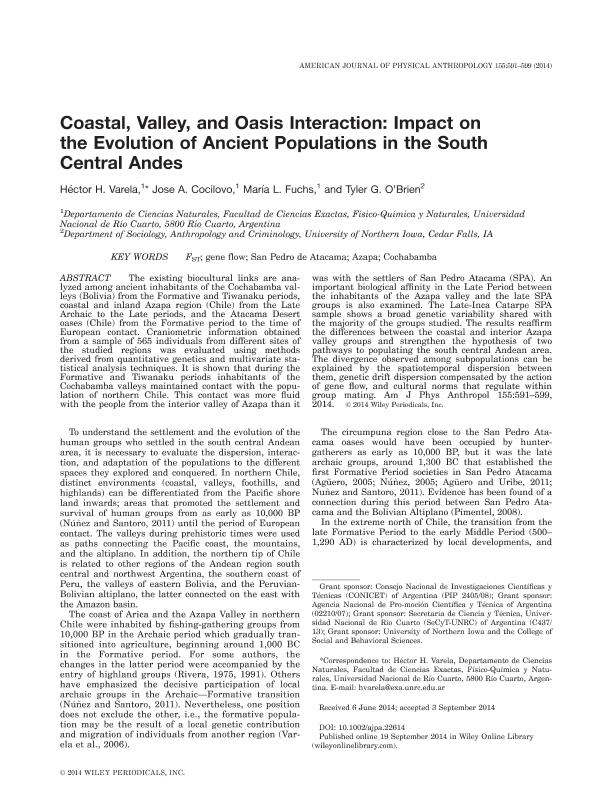
The existing biocultural links are analyzed among ancient inhabitants of the Cochabamba valleys (Bolivia) from the Formative and Tiwanaku periods, coastal and inland Azapa region (Chile) from the Late Archaic to the Late periods, and the Atacama Desert oases (Chile) from the Formative period to the time of European contact. Craniometric information obtained from a sample of 565 individuals from different sites of the studied regions was evaluated using methods derived from quantitative genetics and multivariate statistical analysis techniques. It is shown that during the Formative and Tiwanaku periods inhabitants of the Cochabamba valleys maintained contact with the population of northern Chile. This contact was more fluid with the people from the interior valley of Azapa than it was with the settlers of San Pedro Atacama (SPA). An important biological affinity in the Late Period between the inhabitants of the Azapa valley and the late SPA groups is also examined. The Late-Inca Catarpe SPA sample shows a broad genetic variability shared with the majority of the groups studied. The results reaffirm the differences between the coastal and interior Azapa valley groups and strengthen the hypothesis of two pathways to populating the south central Andean area. The divergence observed among subpopulations can be explained by the spatiotemporal dispersion between them, genetic drift dispersion compensated by the action of gene flow, and cultural norms that regulate within group mating.
Palabras clave:
AZAPA
,
COCHABAMBA
,
FST
,
GENE FLOW
,
SAN PEDRO DE ATACAMA
Archivos asociados

Tamaño:
242.4Kb
Formato:
PDF
Licencia
 Excepto donde se diga explícitamente, este item se publica bajo la siguiente descripción:
Creative Commons Attribution-NonCommercial-ShareAlike 2.5 Unported (CC BY-NC-SA 2.5)
Excepto donde se diga explícitamente, este item se publica bajo la siguiente descripción:
Creative Commons Attribution-NonCommercial-ShareAlike 2.5 Unported (CC BY-NC-SA 2.5)
Identificadores
Colecciones
Articulos(CCT - CORDOBA)
Articulos de CTRO.CIENTIFICO TECNOL.CONICET - CORDOBA
Articulos de CTRO.CIENTIFICO TECNOL.CONICET - CORDOBA
Citación
Varela, Hector Hugo; Cocilovo, Jose Alberto; Fuchs, Maria Laura; O'Brien, Tyler G.; Coastal, valley, and oasis interaction: Impact on the evolution of ancient populations in the south central Andes; Wiley-liss, Div John Wiley & Sons Inc; American Journal Of Physical Anthropology; 155; 4; 12-2014; 591-599
Compartir


Altmétricas