Mostrar el registro sencillo del ítem
dc.contributor.author
Visacovsky, Saba Nerina
dc.date.available
2019-04-30T17:54:17Z
dc.date.issued
2017-09
dc.identifier.citation
Visacovsky, Saba Nerina; Auge y ocaso del shule icufista en Argentina (1941-1968); Centro de Estudios Históricos de los Trabajadores y las Izquierdas; Archivos de historia del movimiento obrero y la izquierda; VI; 11; 9-2017; 121-141
dc.identifier.issn
2313-9749
dc.identifier.uri
http://hdl.handle.net/11336/75361
dc.description.abstract
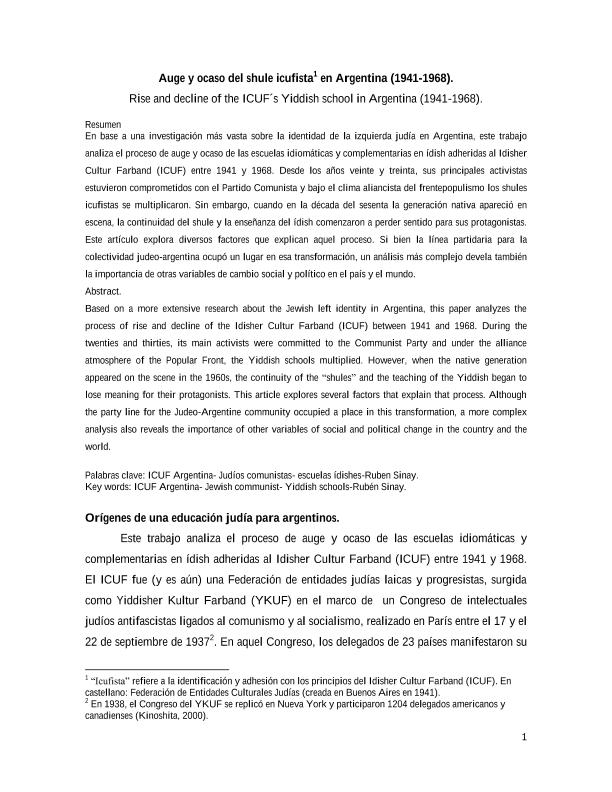
En base a una investigación más vasta sobre la identidad de la izquierda judía en Argentina, este trabajo analiza el proceso de auge y ocaso de las escuelas idiomáticas y complementarias en ídish adheridas al Idisher Cultur Farband (ICUF) entre 1941 y 1968. Desde los años veinte y treinta, sus principales activistas estuvieron comprometidos con el Partido Comunista y bajo el clima aliancista del frentepopulismo los shules icufistas se multiplicaron. Sin embargo, cuando en la década del sesenta la generación nativa apareció en escena, la continuidad del shule y la enseñanza del ídish comenzaron a perder sentido para sus protagonistas. Este artículo explora diversos factores que explican aquel proceso. Si bien la línea partidaria para la colectividad judeo-argentina ocupó un lugar en esa transformación, un análisis más complejo devela también la importancia de otras variables de cambio social y político en el país y el mundo.
dc.description.abstract
Based on a more extensive research about the Jewish left identity in Argentina, this paper analyzes the process of rise and decline of the Idisher Cultur Farband (ICUF) between 1941 and 1968. During the twenties and thirties, its main activists were committed to the Communist Party and under the alliance atmosphere of the Popular Front, the Yiddish schools multiplied. However, when the native generation appeared on the scene in the 1960s, the continuity of the “shules” and the teaching of the Yiddish began to lose meaning for their protagonists. This article explores several factors that explain that process. Although the party line for the Judeo-Argentine community occupied a place in this transformation, a more complex analysis also reveals the importance of other variables of social and political change in the country and the world.
dc.format
application/pdf
dc.language.iso
spa
dc.publisher
Centro de Estudios Históricos de los Trabajadores y las Izquierdas
dc.rights
info:eu-repo/semantics/openAccess
dc.rights.uri
https://creativecommons.org/licenses/by-nc-sa/2.5/ar/
dc.subject
Icuf Argentina
dc.subject
Judios Comunistas
dc.subject
Escuelas Idish
dc.subject
Ruben Sinay
dc.subject.classification
Otras Ciencias Sociales
dc.subject.classification
Otras Ciencias Sociales
dc.subject.classification
CIENCIAS SOCIALES
dc.title
Auge y ocaso del shule icufista en Argentina (1941-1968)
dc.title
Rise and decline of the ICUF´s Yiddish school in Argentina (1941-1968)
dc.type
info:eu-repo/semantics/article
dc.type
info:ar-repo/semantics/artículo
dc.type
info:eu-repo/semantics/publishedVersion
dc.date.updated
2019-04-29T14:04:32Z
dc.journal.volume
VI
dc.journal.number
11
dc.journal.pagination
121-141
dc.journal.pais
Argentina
dc.journal.ciudad
Buenos Aires
dc.description.fil
Fil: Visacovsky, Saba Nerina. Consejo Nacional de Investigaciones Científicas y Técnicas; Argentina
dc.journal.title
Archivos de historia del movimiento obrero y la izquierda
dc.relation.alternativeid
info:eu-repo/semantics/altIdentifier/url/https://www.archivosrevista.com.ar.ca1.toservers.com/contenido/numeros/numero-11/
Archivos asociados

Tamaño:
518.7Kb
Formato:
PDF