Mostrar el registro sencillo del ítem
dc.contributor.author
Cruz, Felix Benjamin
dc.contributor.author
Espinoza, Robert
dc.contributor.author
Tognelli, Marcelo Fabio
dc.date.available
2016-07-29T18:38:19Z
dc.date.issued
2013-01
dc.identifier.citation
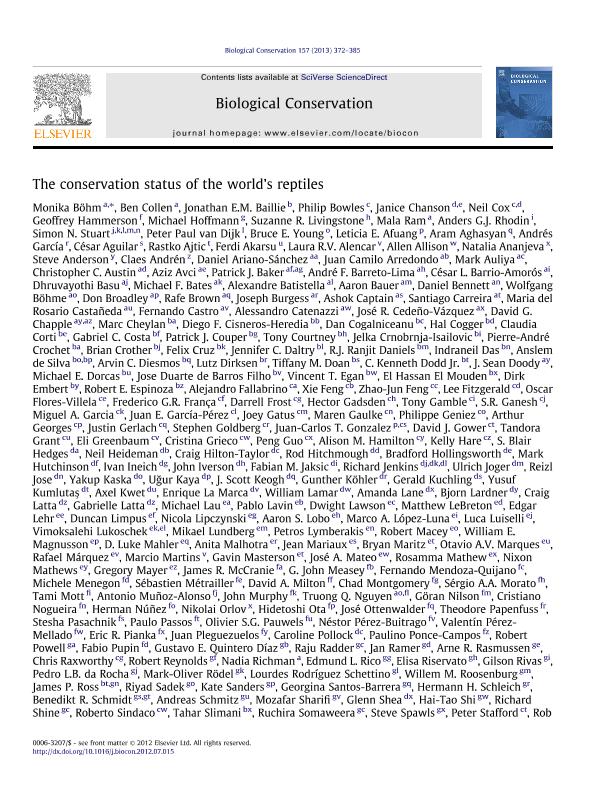
Cruz, Felix Benjamin; Espinoza, Robert; Tognelli, Marcelo Fabio; The conservation status of the world´s reptiles; Elsevier; Biological Conservation; 157; 1-2013; 372-385
dc.identifier.issn
0006-3207
dc.identifier.uri
http://hdl.handle.net/11336/6813
dc.description.abstract
Effective and targeted conservation action requires detailed information about species, their distribution, systematics and ecology as well as the distribution of threat processes which affect them. Knowledge of reptilian diversity remains surprisingly disparate, and innovative means of gaining rapid insight into the status of reptiles are needed in order to highlight urgent conservation cases and inform environmental policy with appropriate biodiversity information in a timely manner. We present the first ever global analysis of extinction risk in reptiles, based on a random representative sample of 1500 species (16% of all currently known species). To our knowledge, our results provide the first analysis of the global conservation status and distribution patterns of reptiles and the threats affecting them, highlighting conservation priorities and knowledge gaps which need to be addressed urgently to ensure the continued survival of the world?s reptiles. Nearly one in five reptilian species are threatened with extinction, with another one in five species classed as Data Deficient. The proportion of threatened reptile species is highest in freshwater environments, tropical regions and on oceanic islands, while data deficiency was highest in tropical areas, such as Central Africa and Southeast Asia, and among fossorial reptiles. Our results emphasise the need for research attention to be focussed on tropical areas which are experiencing the most dramatic rates of habitat loss, on fossorial reptiles for which there is a chronic lack of data, and on certain taxa such as snakes for which extinction risk may currently be underestimated due to lack of population information. Conservation actions specifically need to mitigate the effects of human-induced habitat loss and harvesting, which are the predominant threats to reptiles.
dc.format
application/pdf
dc.language.iso
eng
dc.publisher
Elsevier
dc.rights
info:eu-repo/semantics/openAccess
dc.rights.uri
https://creativecommons.org/licenses/by-nc-nd/2.5/ar/
dc.subject
Reptiles
dc.subject
Global
dc.subject
Conservation
dc.subject
Status
dc.subject.classification
Conservación de la Biodiversidad
dc.subject.classification
Ciencias Biológicas
dc.subject.classification
CIENCIAS NATURALES Y EXACTAS
dc.title
The conservation status of the world´s reptiles
dc.type
info:eu-repo/semantics/article
dc.type
info:ar-repo/semantics/artículo
dc.type
info:eu-repo/semantics/publishedVersion
dc.date.updated
2016-07-28T18:33:50Z
dc.journal.volume
157
dc.journal.pagination
372-385
dc.journal.pais
Países Bajos
dc.journal.ciudad
Amsterdam
dc.description.fil
Fil: Cruz, Felix Benjamin. Consejo Nacional de Investigaciones Científicas y Técnicas. Centro Científico Tecnológico Patagonia Norte. Instituto de Investigación en Biodiversidad y Medioambiente; Argentina
dc.description.fil
Fil: Espinoza, Robert. California State University; Estados Unidos
dc.description.fil
Fil: Tognelli, Marcelo Fabio. Consejo Nacional de Investigaciones Científicas y Técnicas. Centro Científico Tecnológico Mendoza. Instituto Argentino de Investigaciones de Zonas Aridas; Argentina
dc.journal.title
Biological Conservation
dc.relation.alternativeid
info:eu-repo/semantics/altIdentifier/url/http://www.sciencedirect.com/science/article/pii/S0006320712003357
dc.relation.alternativeid
info:eu-repo/semantics/altIdentifier/doi/10.1016/j.biocon.2012.07.015
dc.relation.alternativeid
info:eu-repo/semantics/altIdentifier/doi/http://dx.doi.org/10.1016/j.biocon.2012.07.015
Archivos asociados

Tamaño:
1.180Mb
Formato:
PDF