Mostrar el registro sencillo del ítem
dc.contributor.author
Fraga, Eugenia
dc.date.available
2025-11-18T15:45:44Z
dc.date.issued
2025-02
dc.identifier.citation
Fraga, Eugenia; Cómo ser creadores de teorías en América Latina, según Gino Germani; Universidad Autónoma Metropolitana; Sociológica; 40; 111; 2-2025; 88-106
dc.identifier.issn
2007-8358
dc.identifier.uri
http://hdl.handle.net/11336/275885
dc.description.abstract
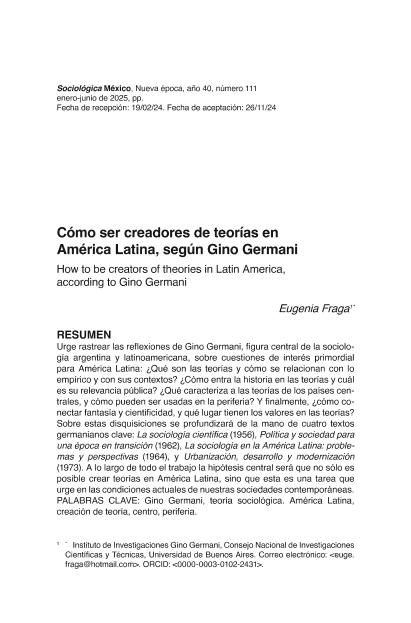
Urge rastrear las reflexiones de Gino Germani, figura central de la sociología argentina y latinoamericana, sobre cuestiones de interés primordial para América Latina: ¿Qué son las teorías y cómo se relacionan con lo empírico y con sus contextos? ¿Cómo entra la historia en las teorías y cuál es su relevancia pública? ¿Qué caracteriza a las teorías de los países centrales, y cómo pueden ser usadas en la periferia? Y finalmente, ¿cómo conectar fantasía y cientificidad, y qué lugar tienen los valores en las teorías? Sobre estas disquisiciones se profundizará de la mano de cuatro textos germanianos clave: La sociología científica (1956), Política y sociedad para una época en transición (1962), La sociología en la América Latina: problemas y perspectivas (1964), y Urbanización, desarrollo y modernización (1973). A lo largo de todo el trabajo la hipótesis central será que no sólo es posible crear teorías en América Latina, sino que esta es una tarea que urge en las condiciones actuales de nuestras sociedades contemporáneas.
dc.description.abstract
tine and Latin American sociology, on questions of primary interest for Latin America: What are theories and how do they relate to the empirical and their contexts? How does history enter into theories and what is its public relevance? What characterizes the theories of central countries, and how can they be used in the periphery? And finally, how to connect fantasy and scientificity, and what place do values have in theories? These disquisitions will be delved into with four key Germanic texts: Scientific Sociology (1956), Politics and Society for an Era in Transition (1962), Sociology in Latin America: Problems and Perspectives (1964), and Urbanization, Development and Modernization (1973). Throughout the entire work, the central hypothesis will be that it is not only possible to create theories in Latin America, but that this is a task that is urgent in the current conditions of our contemporary societies
dc.format
application/pdf
dc.language.iso
spa
dc.publisher
Universidad Autónoma Metropolitana
dc.rights
info:eu-repo/semantics/openAccess
dc.rights.uri
https://creativecommons.org/licenses/by-nc-sa/2.5/ar/
dc.subject
Gino Germani
dc.subject
Teoría sociológica
dc.subject
América Latina
dc.subject
Creación de teoría
dc.subject
Centro y periferia
dc.subject.classification
Otras Sociología
dc.subject.classification
Sociología
dc.subject.classification
CIENCIAS SOCIALES
dc.title
Cómo ser creadores de teorías en América Latina, según Gino Germani
dc.title
How to be creators of theories in Latin America, according to Gino Germani
dc.type
info:eu-repo/semantics/article
dc.type
info:ar-repo/semantics/artículo
dc.type
info:eu-repo/semantics/publishedVersion
dc.date.updated
2025-11-18T13:35:09Z
dc.journal.volume
40
dc.journal.number
111
dc.journal.pagination
88-106
dc.journal.pais
México
dc.journal.ciudad
Ciudad de México
dc.description.fil
Fil: Fraga, Eugenia. Consejo Nacional de Investigaciones Científicas y Técnicas; Argentina. Universidad de Buenos Aires. Facultad de Ciencias Sociales. Instituto de Investigaciones "Gino Germani"; Argentina
dc.journal.title
Sociológica
dc.relation.alternativeid
info:eu-repo/semantics/altIdentifier/url/https://sociologicamexico.azc.uam.mx/index.php/Sociologica/article/view/1813
dc.relation.alternativeid
info:eu-repo/semantics/altIdentifier/doi/https://doi.org/10.24275/HHCZ3925
Archivos asociados

Tamaño:
342.8Kb
Formato:
PDF