Mostrar el registro sencillo del ítem
dc.contributor.author
Berri, Marina
dc.contributor.author
Boschiroli, Victoria de Los Ángeles
dc.date.available
2025-10-14T11:09:17Z
dc.date.issued
2025-08
dc.identifier.citation
Berri, Marina; Boschiroli, Victoria de Los Ángeles; Semantic Verbal Neology in Spanish Dictionaries: Case Study of the Lexicographic Representation of anestesiar and coreografiar; Woordeboek van die Afrikaanse Taal; Lexikos; 35; 8-2025; 367-384
dc.identifier.issn
2224-0039
dc.identifier.uri
http://hdl.handle.net/11336/273382
dc.description.abstract
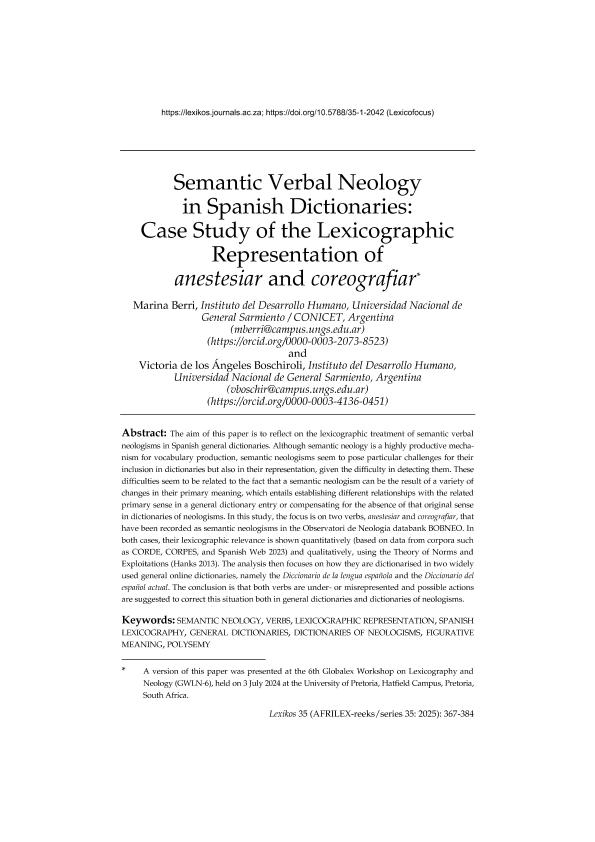
The aim of this paper is to reflect on the lexicographic treatment of semantic verbal neologisms in Spanish general dictionaries. Although semantic neology is a highly productive mechanism for vocabulary production, semantic neologisms seem to pose particular challenges for their inclusion in dictionaries but also in their representation, given the difficulty in detecting them. These difficulties seem to be related to the fact that a semantic neologism can be the result of a variety of changes in their primary meaning, which entails establishing different relationships with the relatedprimary sense in a general dictionary entry or compensating for the absence of that original sensein dictionaries of neologisms. In this study, the focus is on two verbs, anestesiar and coreografiar, that have been recorded as semantic neologisms in the Observatori de Neologia databank BOBNEO. In both cases, their lexicographic relevance is shown quantitatively (based on data from corpora such as CORDE, CORPES, and Spanish Web 2023) and qualitatively, using the Theory of Norms andExploitations (Hanks 2013). The analysis then focuses on how they are dictionarised in two widelyused general online dictionaries, namely the Diccionario de la lengua española and the "Diccionario del español actual". The conclusion is that both verbs are under- or misrepresented and possible actions are suggested to correct this situation both in general dictionaries and dictionaries of neologisms.
dc.description.abstract
Hierdie artikel het besinning oor die leksikografiese hantering van semantiese verbale neologismes in algemene Spaanse woordeboeke ten doel. Alhoewel semantiese neologie 'n hoogs produktiewe werktuig vir woordeskatproduksie is, wil dit voorkom of semantiese neologismes, gegewe die problematiek om hulle op te spoor, besondere uitdagings oplewer in hul insluiting en voorstelling in woordeboeke. Hierdie uitdagings blyk verband te hou daarmee dat semantiese neologismes die resultaat kan wees van verskeie veranderings in hul primêre betekenis, wat kan meebring dat verskillende verhoudings met die verwante primêre betekenis in 'n algemene woordeboek gevestig moet word, of dat daar vir die afwesigheid van daardie oorspronklike betekenis in neologismewoordeboeke gekompenseer moet word. In hierdie studie is die fokus op twee werkwoorde, anestesiar en coreografiar, wat as semantiese neologismes in die Observatori de Neologia-databasis BOBNEO opgeteken is. In albei gevalle word hul leksikografiese relevansie kwantitatief (gebaseer op data uit korpusse soos CORDE, CORPES en Spanish Web 2023), asook kwalitatief met behulp van die Teorie van Norme en Eksploitasies (Hanks 2013) aangedui. Die analise fokus vervolgens op hoe hierdie werkwoorde in twee wyd gebruikte algemene aanlyn woordeboeke, naamlik die Diccionario de la lengua española en die Diccionario del español actual, opgeneem is. Daar word tot die gevolgtrekking gekom dat beide werkwoorde onderverteenwoordig of verkeerd voorgestel word, en moontlikhede word aan die hand gedoen om hierdie situasie in sowel algemene woordeboeke as neologismewoordeboeke reg te stel.
dc.format
application/pdf
dc.language.iso
eng
dc.publisher
Woordeboek van die Afrikaanse Taal
dc.rights
info:eu-repo/semantics/openAccess
dc.rights.uri
https://creativecommons.org/licenses/by/2.5/ar/
dc.subject
SEMANTIC NEOLOGY
dc.subject
VERBS
dc.subject
LEXICOGRAPHIC REPRESENTATION
dc.subject
FIGURATIVE MEANING
dc.subject.classification
Lingüística
dc.subject.classification
Lengua y Literatura
dc.subject.classification
HUMANIDADES
dc.title
Semantic Verbal Neology in Spanish Dictionaries: Case Study of the Lexicographic Representation of anestesiar and coreografiar
dc.title
Opsomming: Semantiese verbale neologie in Spaanse woordeboeke: 'n Gevallestudie van die leksikografiese voorstelling van anestesiar en coreografiar
dc.type
info:eu-repo/semantics/article
dc.type
info:ar-repo/semantics/artículo
dc.type
info:eu-repo/semantics/publishedVersion
dc.date.updated
2025-10-13T13:24:20Z
dc.journal.volume
35
dc.journal.pagination
367-384
dc.journal.pais
Sudáfrica
dc.description.fil
Fil: Berri, Marina. Consejo Nacional de Investigaciones Científicas y Técnicas; Argentina. Universidad de Buenos Aires; Argentina. Universidad Nacional de General Sarmiento. Instituto del Desarrollo Humano; Argentina
dc.description.fil
Fil: Boschiroli, Victoria de Los Ángeles. Universidad Nacional de General Sarmiento. Instituto del Desarrollo Humano; Argentina
dc.journal.title
Lexikos
dc.relation.alternativeid
info:eu-repo/semantics/altIdentifier/url/https://lexikos.journals.ac.za/pub/article/view/2042
dc.relation.alternativeid
info:eu-repo/semantics/altIdentifier/doi/http://dx.doi.org/10.5788/35-1-2042
Archivos asociados

Tamaño:
960.1Kb
Formato:
PDF