Artículo
Pharmacokinetic Analysis of Melphalan after Superselective Ophthalmic Artery Infusion in Preclinical Models and Retinoblastoma Patients
Schaiquevich, Paula Susana ; Buitrago, Emiliano; Taich, Paula Juliana
; Torbidoni, Ana Vanesa
; Ceciliano, Alejandro; Fandino, Adriana; Asprea, Marcelo; Requejo, Flavio; Abramson, David H.; Bramuglia, Guillermo Federico; Chantada, Guillermo Luis
; Buitrago, Emiliano; Taich, Paula Juliana
; Torbidoni, Ana Vanesa
; Ceciliano, Alejandro; Fandino, Adriana; Asprea, Marcelo; Requejo, Flavio; Abramson, David H.; Bramuglia, Guillermo Federico; Chantada, Guillermo Luis
; Buitrago, Emiliano; Taich, Paula Juliana
; Torbidoni, Ana Vanesa
; Ceciliano, Alejandro; Fandino, Adriana; Asprea, Marcelo; Requejo, Flavio; Abramson, David H.; Bramuglia, Guillermo Federico; Chantada, Guillermo Luis
Fecha de publicación:
05/2012
Editorial:
Association for Research in Vision and Ophthalmology
Revista:
Investigative Opthalmology & Visual Science
ISSN:
0146-0404
e-ISSN:
1552-5783
Idioma:
Inglés
Tipo de recurso:
Artículo publicado
Clasificación temática:
Resumen
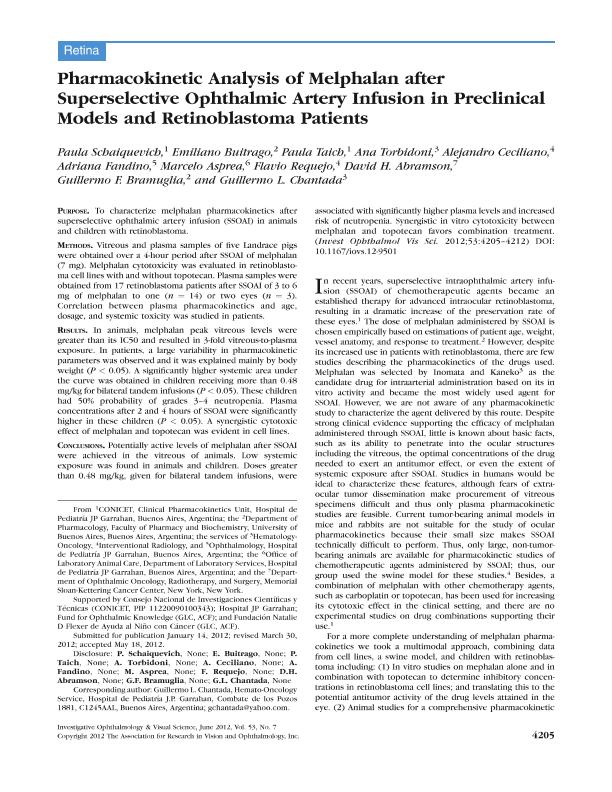
Purpose: To characterize melphalan pharmacokinetics after super-selective ophthalmic artery infusion (SSOAI) in animals and children with retinoblastoma. Methods: Vitreous and plasma samples of 5 Landrace pigs were obtained over a 4-hour period after SSOAI of melphalan (7 mg). Melphalan 50 % inhibitory concentration (IC50) was evaluated in retinoblastoma cell lines. Plasma samples were obtained from 17 retinoblastoma patients after SSOAI of 3 to 6 mg of melphalan to one (n=14) or two eyes (n=3). Correlation between plasma pharmacokinetics and age, dosage and systemic toxicity was studied in patients. Results: In animals, melphalan peak vitreous levels were greater than its IC50 and resulted in 3-fold vitreous-to-plasma exposure. In patients, large variability in pharmacokinetic parameters was observed and it was explained mainly by body weight (p< 0.05). A significantly higher systemic area under the curve was obtained in children receiving more than 0.48 mg/kg for bilateral tandem infusions (p< 0.05). These children had 50 % probability of grade 3-4 neutropenia. Plasma concentrations after 2 and 4 hours of SSOAI were significantly higher in these children (p< 0.05). A synergistic cytotoxic effect of melphalan and topotecan was evident in cell lines (p<0.001). Conclusions. Potentially active levels of melphalan after SSOAI were achieved in the vitreous of animals. Low systemic exposure was found in animals and children. Doses greater than 0.48 mg/kg, given for bilateral tandem infusions, were associated with significantly higher plasma levels and increased risk of neutropenia. Synergistic in vitro cytotoxicity between melphalan and topotecan favors combination treatment.
Archivos asociados

Tamaño:
234.2Kb
Formato:
PDF
Licencia
 Excepto donde se diga explícitamente, este item se publica bajo la siguiente descripción:
Creative Commons Attribution-NonCommercial-ShareAlike 2.5 Unported (CC BY-NC-SA 2.5)
Excepto donde se diga explícitamente, este item se publica bajo la siguiente descripción:
Creative Commons Attribution-NonCommercial-ShareAlike 2.5 Unported (CC BY-NC-SA 2.5)
Identificadores
Colecciones
Articulos(SEDE CENTRAL)
Articulos de SEDE CENTRAL
Articulos de SEDE CENTRAL
Citación
Schaiquevich, Paula Susana; Buitrago, Emiliano; Taich, Paula Juliana; Torbidoni, Ana Vanesa; Ceciliano, Alejandro; et al.; Pharmacokinetic Analysis of Melphalan after Superselective Ophthalmic Artery Infusion in Preclinical Models and Retinoblastoma Patients; Association for Research in Vision and Ophthalmology; Investigative Opthalmology & Visual Science; 53; 7; 5-2012; 4205-4212
Compartir


Altmétricas