Artículo
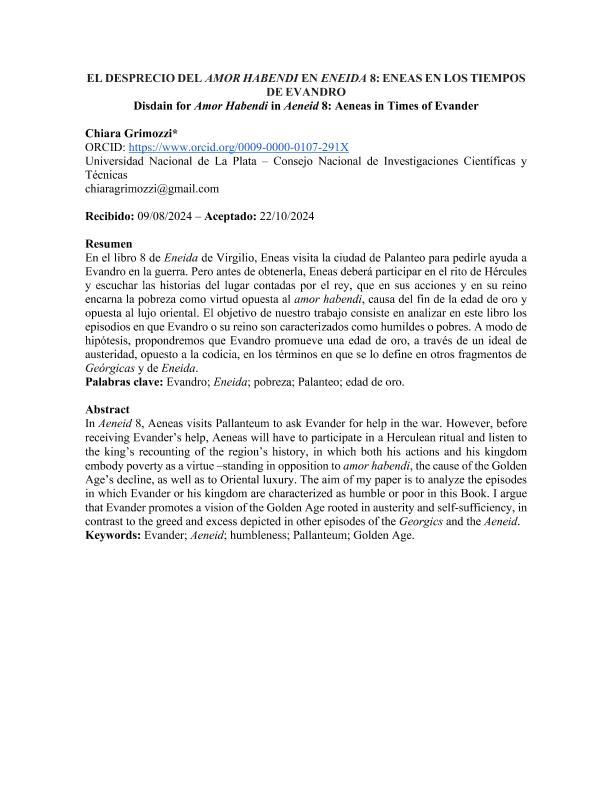
En el libro 8 de Eneida de Virgilio, Eneas visita la ciudad de Palanteo para pedirle ayuda a Evandro en la guerra. Pero antes de obtenerla, Eneas deberá participar en el rito de Hércules y escuchar las historias del lugar contadas por el rey, que en sus acciones y en su reino encarna la pobreza como virtud opuesta al amor habendi, causa del fin de la edad de oro y opuesta al lujo oriental. El objetivo de nuestro trabajo consiste en analizar en este libro los episodios en que Evandro o su reino son caracterizados como humildes o pobres. A modo de hipótesis, propondremos que Evandro promueve una edad de oro, a través de un ideal de austeridad, opuesto a la codicia, en los términos en que se lo define en otros fragmentos de Geórgicas y de Eneida. In Aeneid 8, Aeneas visits Pallanteum to ask Evander for help in the war. However, before receiving Evander’s help, Aeneas will have to participate in a Herculean ritual and listen to the king’s recounting of the region’s history, in which both his actions and his kingdom embody poverty as a virtue –standing in opposition to amor habendi, the cause of the Golden Age’s decline, as well as to Oriental luxury. The aim of my paper is to analyze the episodes in which Evander or his kingdom are characterized as humble or poor in this Book. I argue that Evander promotes a vision of the Golden Age rooted in austerity and self-sufficiency, in contrast to the greed and excess depicted in other episodes of the Georgics and the Aeneid.
El desprecio del amor habendi en Eneida 8: Eneas en los tiempos de Evandro
Título:
Disdain for Amor Habendi in Aeneid 8: Aeneas in Times of Evander

Fecha de publicación:
12/2024
Editorial:
Universidad Nacional del Nordeste
Revista:
Cuadernos de Literatura
ISSN:
0326-5102
e-ISSN:
2684-0499
Idioma:
Español
Tipo de recurso:
Artículo publicado
Clasificación temática:
Resumen
Palabras clave:
EVANDRO
,
ENEIDA
,
POBREZA
,
PALANTEO
,
EDAD DE ORO
Archivos asociados

Tamaño:
374.7Kb
Formato:
PDF
Licencia
 Excepto donde se diga explícitamente, este item se publica bajo la siguiente descripción:
Creative Commons Attribution-NonCommercial 2.5 Unported (CC BY-NC 2.5)
Excepto donde se diga explícitamente, este item se publica bajo la siguiente descripción:
Creative Commons Attribution-NonCommercial 2.5 Unported (CC BY-NC 2.5)
Identificadores
Colecciones
Articulos(IDIHCS)
Articulos de INST.DE INVEST.EN HUMANIDADES Y CS SOCIALES
Articulos de INST.DE INVEST.EN HUMANIDADES Y CS SOCIALES
Citación
Grimozzi, Chiara; El desprecio del amor habendi en Eneida 8: Eneas en los tiempos de Evandro; Universidad Nacional del Nordeste; Cuadernos de Literatura; 25; 12-2024; 1-14
Compartir


Altmétricas