Artículo
Vertical zonation or allogenic succession? Sclerobionts on a coral patch-reef from the Lower Cretaceous Agrio Formation, Neuquén Basin, west-central Argentina

Fecha de publicación:
11/2025
Editorial:
Elsevier Science
Revista:
Palaeogeography, Palaeoclimatology, Palaeoecology
ISSN:
0031-0182
Idioma:
Inglés
Tipo de recurso:
Artículo publicado
Clasificación temática:
Resumen
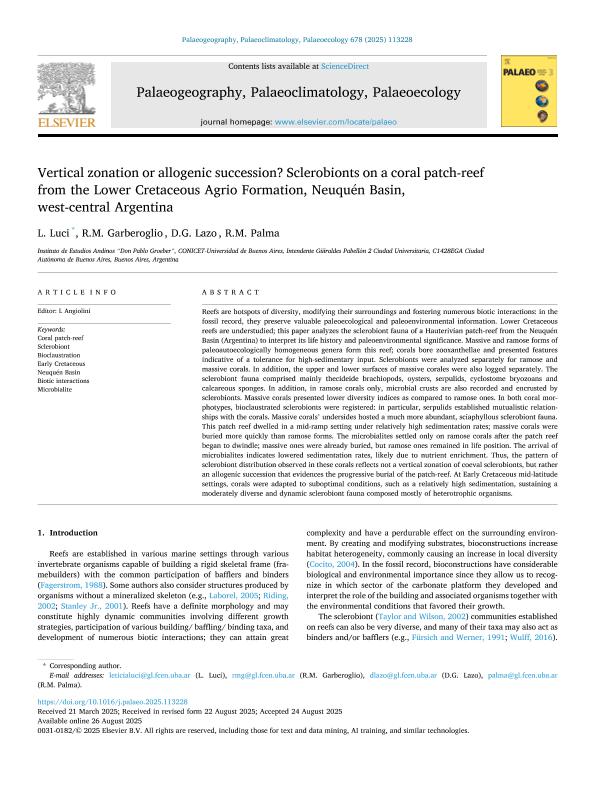
Reefs are hotspots of diversity, modifying their surroundings and fostering numerous biotic interactions: in the fossil record, they preserve valuable paleoecological and paleoenvironmental information. Lower Cretaceous reefs are understudied; this paper analyzes the sclerobiont fauna of a Hauterivian patch-reef from the Neuquen Basin (Argentina) to interpret its life history and paleoenvironmental significance. Massive and ramose forms of paleoautoecologically homogeneous genera form this reef; corals bore zooxanthellae and presented features indicative of a tolerance for high-sedimentary input. Sclerobionts were analyzed separately for ramose and massive corals. In addition, the upper and lower surfaces of massive corales were also logged separately. The sclerobiont fauna comprised mainly thecideide brachiopods, oysters, serpulids, cyclostome bryozoans and calcareous sponges. In addition, in ramose corals only, microbial crusts are also recorded and encrusted by sclerobionts. Massive corals presented lower diversity indices as compared to ramose ones. In both coral morphotypes, bioclaustrated sclerobionts were registered: in particular, serpulids established mutualistic relationships with the corals. Massive corals’ undersides hosted a much more abundant, sciaphyllous sclerobiont fauna. This patch reef dwelled in a mid-ramp setting under relatively high sedimentation rates; massive corals were buried more quickly than ramose forms. The microbialites settled only on ramose corals after the patchreef began to dwindle; massive ones were already buried, but ramose ones remained in life position. The arrival of microbialites indicates lowered sedimentation rates, likely due to nutrient enrichment. Thus, the pattern of sclerobiont distribution observed in these corals reflects not a vertical zonation of coeval sclerobionts, but rather an allogenic succession that evidences the progressive burial of the patch-reef. At Early Cretaceous mid-latitude settings, corals were adapted to suboptimal conditions, such as a relatively high sedimentation, sustaining a moderately diverse and dynamic sclerobiont fauna composed mostly of heterotrophic organisms.
Palabras clave:
Encrustation
,
Scleractinia
,
Oyster
,
Brachiopoda
Archivos asociados

Tamaño:
28.48Mb
Formato:
PDF
Licencia
 Excepto donde se diga explícitamente, este item se publica bajo la siguiente descripción:
Creative Commons Attribution-NonCommercial-ShareAlike 2.5 Unported (CC BY-NC-SA 2.5)
Excepto donde se diga explícitamente, este item se publica bajo la siguiente descripción:
Creative Commons Attribution-NonCommercial-ShareAlike 2.5 Unported (CC BY-NC-SA 2.5)
Identificadores
Colecciones
Articulos(IDEAN)
Articulos de INSTITUTO DE ESTUDIOS ANDINOS "DON PABLO GROEBER"
Articulos de INSTITUTO DE ESTUDIOS ANDINOS "DON PABLO GROEBER"
Citación
Luci, Leticia; Garberoglio, Ricardo Miguel; Lazo, Dario Gustavo; Palma, Ricardo Manuel; Vertical zonation or allogenic succession? Sclerobionts on a coral patch-reef from the Lower Cretaceous Agrio Formation, Neuquén Basin, west-central Argentina; Elsevier Science; Palaeogeography, Palaeoclimatology, Palaeoecology; 678; 113228; 11-2025; 1-17
Compartir


Altmétricas