Mostrar el registro sencillo del ítem
dc.contributor.author
Andreoli, Maria Florencia
dc.contributor.author
Kruger, Ana Luz
dc.contributor.author
Sokolov, Aleksandr V.
dc.contributor.author
Rukh, Gull
dc.contributor.author
de Francesco, Pablo Nicolás
dc.contributor.author
Perello, Mario
dc.contributor.author
Schiöth, Helgi B.
dc.date.available
2025-06-25T09:16:58Z
dc.date.issued
2024-08
dc.identifier.citation
Andreoli, Maria Florencia; Kruger, Ana Luz; Sokolov, Aleksandr V.; Rukh, Gull; de Francesco, Pablo Nicolás; et al.; LEAP2 is associated with impulsivity and reward sensitivity depending on the nutritional status and decreases with protein intake in humans; Wiley Blackwell Publishing, Inc; Diabetes Obesity & Metabolism; 26; 10; 8-2024; 4734-4743
dc.identifier.issn
1462-8902
dc.identifier.uri
http://hdl.handle.net/11336/264496
dc.description.abstract
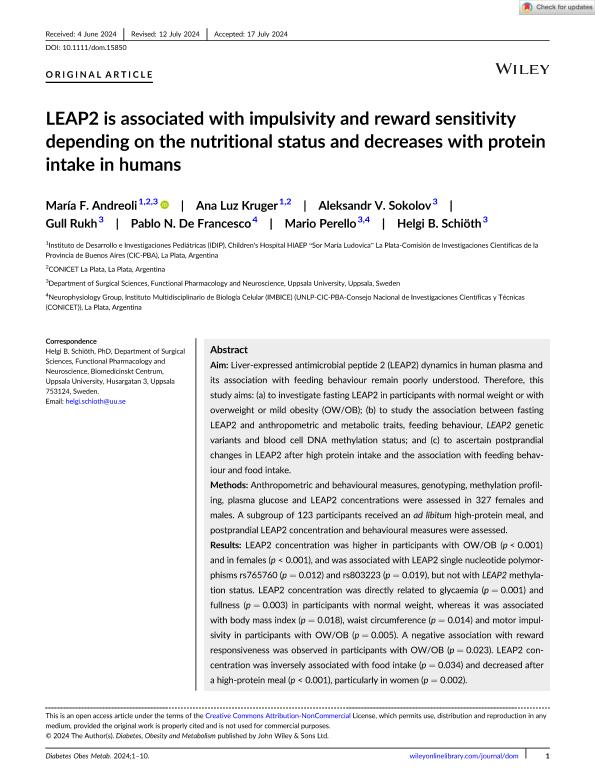
Aim: Liver-expressed antimicrobial peptide 2 (LEAP2) dynamics in human plasma and its association with feeding behaviour remain poorly understood. Therefore, this study aims: (a) to investigate fasting LEAP2 in participants with normal weight or with overweight or mild obesity (OW/OB); (b) to study the association between fasting LEAP2 and anthropometric and metabolic traits, feeding behaviour, LEAP2 genetic variants and blood cell DNA methylation status; and (c) to ascertain postprandial changes in LEAP2 after high protein intake and the association with feeding behaviour and food intake. Methods: Anthropometric and behavioural measures, genotyping, methylation profiling, plasma glucose and LEAP2 concentrations were assessed in 327 females and males. A subgroup of 123 participants received an ad libitum high-protein meal, and postprandial LEAP2 concentration and behavioural measures were assessed. Results: LEAP2 concentration was higher in participants with OW/OB (p < 0.001) and in females (p < 0.001), and was associated with LEAP2 single nucleotide polymorphisms rs765760 (p = 0.012) and rs803223 (p = 0.019), but not with LEAP2 methylation status. LEAP2 concentration was directly related to glycaemia (p = 0.001) and fullness (p = 0.003) in participants with normal weight, whereas it was associated with body mass index (p = 0.018), waist circumference (p = 0.014) and motor impulsivity in participants with OW/OB (p = 0.005). A negative association with reward responsiveness was observed in participants with OW/OB (p = 0.023). LEAP2 concentration was inversely associated with food intake (p = 0.034) and decreased after a high-protein meal (p < 0.001), particularly in women (p = 0.002). Conclusion: Increased LEAP2 in participants with OW/OB is associated with behavioural characteristics of obesity. Our results show sexual dimorphism in LEAP2 concentration before and after food intake and highlight the role of LEAP2 in feeding regulation.
dc.format
application/pdf
dc.language.iso
eng
dc.publisher
Wiley Blackwell Publishing, Inc
dc.rights
info:eu-repo/semantics/openAccess
dc.rights.uri
https://creativecommons.org/licenses/by-nc/2.5/ar/
dc.subject
LEAP2
dc.subject
FEEDING BEHAVIOUR
dc.subject
FOOD INTAKE
dc.subject
IMPULSIVITY
dc.subject
REWARD SENSITIVITY
dc.subject.classification
Neurociencias
dc.subject.classification
Medicina Básica
dc.subject.classification
CIENCIAS MÉDICAS Y DE LA SALUD
dc.title
LEAP2 is associated with impulsivity and reward sensitivity depending on the nutritional status and decreases with protein intake in humans
dc.type
info:eu-repo/semantics/article
dc.type
info:ar-repo/semantics/artículo
dc.type
info:eu-repo/semantics/publishedVersion
dc.date.updated
2025-06-23T13:39:23Z
dc.journal.volume
26
dc.journal.number
10
dc.journal.pagination
4734-4743
dc.journal.pais
Reino Unido
dc.journal.ciudad
Londres
dc.description.fil
Fil: Andreoli, Maria Florencia. Provincia de Buenos Aires. Ministerio de Salud. Hospital de Niños "Sor María Ludovica" de La Plata. Instituto de Desarrollo e Investigaciones Pediátricas; Argentina. Consejo Nacional de Investigaciones Científicas y Técnicas. Centro Científico Tecnológico Conicet - La Plata; Argentina
dc.description.fil
Fil: Kruger, Ana Luz. Consejo Nacional de Investigaciones Científicas y Técnicas. Centro Científico Tecnológico Conicet - La Plata; Argentina. Provincia de Buenos Aires. Ministerio de Salud. Hospital de Niños "Sor María Ludovica" de La Plata. Instituto de Desarrollo e Investigaciones Pediátricas; Argentina
dc.description.fil
Fil: Sokolov, Aleksandr V.. Uppsala Universitet; Suecia
dc.description.fil
Fil: Rukh, Gull. Uppsala Universitet; Suecia
dc.description.fil
Fil: de Francesco, Pablo Nicolás. Consejo Nacional de Investigaciones Científicas y Técnicas. Centro Científico Tecnológico Conicet - La Plata. Instituto Multidisciplinario de Biología Celular. Provincia de Buenos Aires. Gobernación. Comisión de Investigaciones Científicas. Instituto Multidisciplinario de Biología Celular. Universidad Nacional de La Plata. Instituto Multidisciplinario de Biología Celular; Argentina
dc.description.fil
Fil: Perello, Mario. Consejo Nacional de Investigaciones Científicas y Técnicas. Centro Científico Tecnológico Conicet - La Plata. Instituto Multidisciplinario de Biología Celular. Provincia de Buenos Aires. Gobernación. Comisión de Investigaciones Científicas. Instituto Multidisciplinario de Biología Celular. Universidad Nacional de La Plata. Instituto Multidisciplinario de Biología Celular; Argentina
dc.description.fil
Fil: Schiöth, Helgi B.. Uppsala Universitet; Suecia
dc.journal.title
Diabetes Obesity & Metabolism
dc.relation.alternativeid
info:eu-repo/semantics/altIdentifier/url/https://dom-pubs.pericles-prod.literatumonline.com/doi/10.1111/dom.15850
dc.relation.alternativeid
info:eu-repo/semantics/altIdentifier/doi/http://dx.doi.org/10.1111/dom.15850
Archivos asociados

Tamaño:
1.050Mb
Formato:
PDF