Mostrar el registro sencillo del ítem
dc.contributor.author
Cherniavsky, Axel
dc.date.available
2025-04-08T12:44:27Z
dc.date.issued
2024-07
dc.identifier.citation
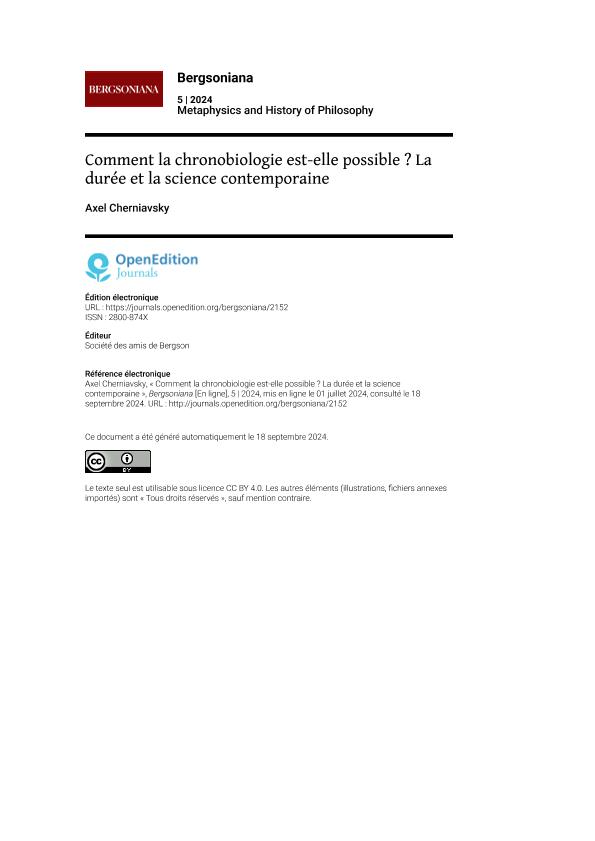
Cherniavsky, Axel; Comment la chronobiologie est-elle possible?: La durée et la science contemporaine; Société des amis de Bergson; Bergsoniana; 5; 7-2024; 1-18
dc.identifier.issn
2800-874X
dc.identifier.uri
http://hdl.handle.net/11336/258300
dc.description.abstract
By focusing on the mechanisms that allow living beings to synchronize with their environment, chronobiology is based on the notion of time more than biology had ever done before. But what concept of time this branch of biology presupposes? Is it what Bergson called “homogeneous time,” that mixture of space and time that he considered so necessary and useful to science? Or is it the continuous and heterogeneous duration that he distinguished from it? It is neither entirely one nor the other: chronobiology presupposes a homogeneous time that can be divided and measured, but also an elastic duration composed of several rhythms. However, the answer to these questions will lead us beyond chronobiology and even beyond the concept of time. On the one hand, given that the theory of the rhythms of duration makes space itself a rhythm of it, it also allows us to ask what concept of space chronobiology presupposes. And on the other hand, given that the study of synchrony goes beyond chronobiology, it allows us to question whether the concept of duration does not also make possible a study of the cycles of nature and of physical clocks.
dc.description.abstract
En s’intéressant aux mécanismes qui permettent aux êtres vivants de se synchroniser avec leur environnement, la chronobiologie s’est appuyée sur la notion du temps, plus que la biologie ne l’avait jamais fait. Mais quel est le concept du temps que cette branche de la biologie présuppose ? S’agit-il du « temps homogène », ce mélange d’espace et de temps que Bergson jugeait si nécessaire et utile aux sciences ? Ou bien de la durée continue et hétérogène qu’il distinguait de celui-ci ? Il ne s’agit ni entièrement de l’un, ni de l’autre : la chronobiologie présuppose un temps homogène, que l’on peut diviser et mesurer, mais aussi une durée élastique, composée de plusieurs rythmes. Or la réponse aux questions posées va mener au-delà de la chronobiologie, et même du concept du temps. D’un côté, la théorie des rythmes de la durée fait de l’espace lui-même un rythme de celle-ci, et permet donc de s’interroger sur le concept d’espace présupposé par la chronobiologie. De l’autre, étant donné que l’étude de la synchronie dépasse la chronobiologie, elle permet de se demander si le concept de la durée rend également possible une étude des cycles de la nature et des horloges physiques.
dc.format
application/pdf
dc.language.iso
fra
dc.publisher
Société des amis de Bergson
dc.rights
info:eu-repo/semantics/openAccess
dc.rights.uri
https://creativecommons.org/licenses/by/2.5/ar/
dc.subject
DURÉE
dc.subject
ÉLASTICITÉ
dc.subject
RYTHMES BIOLOGIQUES
dc.subject
HORLOGES PHYSIQUES
dc.subject.classification
Otras Filosofía, Étnica y Religión
dc.subject.classification
Filosofía, Ética y Religión
dc.subject.classification
HUMANIDADES
dc.title
Comment la chronobiologie est-elle possible?: La durée et la science contemporaine
dc.type
info:eu-repo/semantics/article
dc.type
info:ar-repo/semantics/artículo
dc.type
info:eu-repo/semantics/publishedVersion
dc.date.updated
2025-04-01T13:34:32Z
dc.journal.number
5
dc.journal.pagination
1-18
dc.journal.pais
Francia
dc.journal.ciudad
París
dc.description.fil
Fil: Cherniavsky, Axel. Centro de Investigaciones Filosóficas. Instituto de Filosofía "Ezequiel de Olaso". - Consejo Nacional de Investigaciones Científicas y Técnicas. Oficina de Coordinación Administrativa Ciudad Universitaria. Instituto de Filosofía "Ezequiel de Olaso".; Argentina
dc.journal.title
Bergsoniana
dc.relation.alternativeid
info:eu-repo/semantics/altIdentifier/url/https://journals.openedition.org/bergsoniana/2152
dc.relation.alternativeid
info:eu-repo/semantics/altIdentifier/doi/https://doi.org/10.4000/12b4c
Archivos asociados

Tamaño:
216.6Kb
Formato:
PDF