Mostrar el registro sencillo del ítem
dc.contributor.author
Bolaños, Martin
dc.date.available
2025-03-12T15:03:43Z
dc.date.issued
2024-11
dc.identifier.citation
Bolaños, Martin; Singularidades y ritornellos: Patagonia como tierra sin paisaje; Universidad Nacional de la Patagonia Austral; Hermeneutic; 25; 11-2024; 111-120
dc.identifier.uri
http://hdl.handle.net/11336/256059
dc.description.abstract
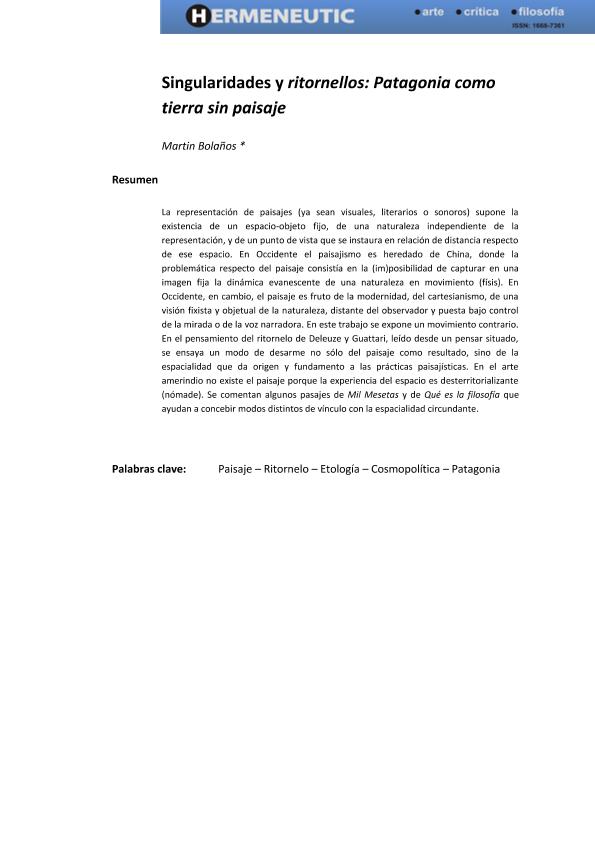
La representación de paisajes (ya sean visuales, literarios o sonoros) supone laexistencia de un espacio-objeto fijo, de una naturaleza independiente de larepresentación, y de un punto de vista que se instaura en relación de distancia respectode ese espacio. En Occidente el paisajismo es heredado de China, donde laproblemática respecto del paisaje consistía en la (im)posibilidad de capturar en unaimagen fija la dinámica evanescente de una naturaleza en movimiento (físis). EnOccidente, en cambio, el paisaje es fruto de la modernidad, del cartesianismo, de unavisión fixista y objetual de la naturaleza, distante del observador y puesta bajo controlde la mirada o de la voz narradora. En este trabajo se expone un movimiento contrario.En el pensamiento del ritornelo de Deleuze y Guattari, leído desde un pensar situado,se ensaya un modo de desarme no sólo del paisaje como resultado, sino de laespacialidad que da origen y fundamento a las prácticas paisajísticas. En el arteamerindio no existe el paisaje porque la experiencia del espacio es desterritorializante(nómade). Se comentan algunos pasajes de Mil Mesetas y de Qué es la filosofía queayudan a concebir modos distintos de vínculo con la espacialidad circundante.
dc.description.abstract
The idea and representation of landscapes (whether visual, literary or sound) suppose the existence of a fixed space-object, of a nature independent of the representation, and of a point of view that is established in a relationship of distance with respect to that space. In the West, landscaping is inherited from China, where the problem with the landscape consisted of the (im)possibility of capturing in a fixed image the evanescent dynamics of a nature understood as a series of transformations or mutations of complementary elements (I Ching). In the West, on the other hand, the landscape is the result of modernity, of cartesianism, of a fixist and objectual vision of nature, distant from the observer and placed under the control of the gaze or the narrating voice. This contribution exposes a contrary movement. In the thought of Deleuze and Guattari's ritornello, read from a situated thought, a way of disarming not only the landscape as a result, but also the spatiality that gives origin and foundation to landscape practices is tested. In Amerindian art there is no landscape because the experience of space is deterritorializing (nomadic), which entails aesthetic-cosmopolitical consequences. Some passages from A Thousand Plateaus and What is Philosophy are discussed, which help to feel-think different ways of linking with the surrounding spatiality.
dc.format
application/pdf
dc.language.iso
spa
dc.publisher
Universidad Nacional de la Patagonia Austral
dc.rights
info:eu-repo/semantics/openAccess
dc.rights.uri
https://creativecommons.org/licenses/by-nc-nd/2.5/ar/
dc.subject
PAISAJE
dc.subject
RITORNELO
dc.subject
ETOLOGIA
dc.subject
PATAGONIA
dc.subject.classification
Otras Filosofía, Étnica y Religión
dc.subject.classification
Filosofía, Ética y Religión
dc.subject.classification
HUMANIDADES
dc.title
Singularidades y ritornellos: Patagonia como tierra sin paisaje
dc.title
Singularities and 'ritornellos': Patagonia as a land without landscape
dc.type
info:eu-repo/semantics/article
dc.type
info:ar-repo/semantics/artículo
dc.type
info:eu-repo/semantics/publishedVersion
dc.date.updated
2025-03-11T12:06:35Z
dc.identifier.eissn
1668-7361
dc.journal.number
25
dc.journal.pagination
111-120
dc.journal.pais
Argentina
dc.description.fil
Fil: Bolaños, Martin. Consejo Nacional de Investigaciones Científicas y Técnicas; Argentina. Universidad Nacional de la Patagonia Austral; Argentina
dc.journal.title
Hermeneutic
dc.relation.alternativeid
info:eu-repo/semantics/altIdentifier/url/https://publicaciones.unpa.edu.ar/hermeneutic
dc.relation.alternativeid
info:eu-repo/semantics/altIdentifier/doi/http://dx.doi.org/10.22305/hermeneutic-unpa.n25.a2024.1126
Archivos asociados

Tamaño:
776.8Kb
Formato:
PDF