Mostrar el registro sencillo del ítem
dc.contributor.author
Derks, Britt
dc.contributor.author
Demirbas, Didem
dc.contributor.author
Arantes, Rodrigo R.
dc.contributor.author
Banford, Samantha
dc.contributor.author
Burlina, Alberto B.
dc.contributor.author
Cabrera, Analía
dc.contributor.author
Chiesa, Ana Elena
dc.contributor.author
Couce, M. Luz
dc.contributor.author
Dionisi Vici, Carlo
dc.contributor.author
Gautschi, Matthias
dc.contributor.author
Grünewald, Stephanie
dc.contributor.author
Morava, Eva
dc.contributor.author
Möslinger, Dorothea
dc.contributor.author
Scholl Bürgi, Sabine
dc.contributor.author
Skouma, Anastasia
dc.contributor.author
Stepien, Karolina M.
dc.contributor.author
Timson, David J.
dc.contributor.author
Berry, Gerard T.
dc.contributor.author
Rubio Gozalbo, M. Estela
dc.date.available
2023-09-29T17:18:28Z
dc.date.issued
2022-12
dc.identifier.citation
Derks, Britt; Demirbas, Didem; Arantes, Rodrigo R.; Banford, Samantha; Burlina, Alberto B.; et al.; Galactose epimerase deficiency: lessons from the GalNet registry; BioMed Central; Orphanet Journal Of Rare Diseases; 17; 1; 12-2022; 1-12
dc.identifier.issn
1750-1172
dc.identifier.uri
http://hdl.handle.net/11336/213633
dc.description.abstract
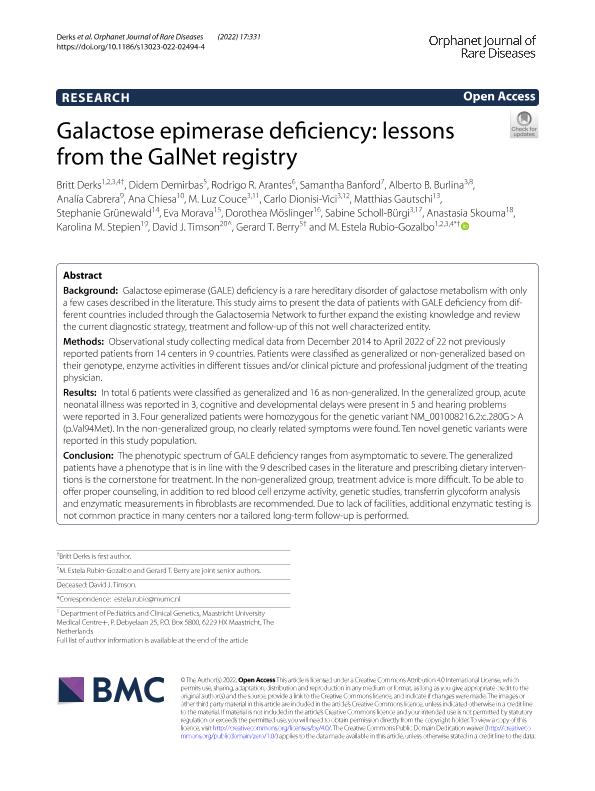
Background: Galactose epimerase (GALE) deficiency is a rare hereditary disorder of galactose metabolism with only a few cases described in the literature. This study aims to present the data of patients with GALE deficiency from different countries included through the Galactosemia Network to further expand the existing knowledge and review the current diagnostic strategy, treatment and follow-up of this not well characterized entity. Methods: Observational study collecting medical data from December 2014 to April 2022 of 22 not previously reported patients from 14 centers in 9 countries. Patients were classified as generalized or non-generalized based on their genotype, enzyme activities in different tissues and/or clinical picture and professional judgment of the treating physician. Results: In total 6 patients were classified as generalized and 16 as non-generalized. In the generalized group, acute neonatal illness was reported in 3, cognitive and developmental delays were present in 5 and hearing problems were reported in 3. Four generalized patients were homozygous for the genetic variant NM_001008216.2:c.280G > A (p.Val94Met). In the non-generalized group, no clearly related symptoms were found. Ten novel genetic variants were reported in this study population. Conclusion: The phenotypic spectrum of GALE deficiency ranges from asymptomatic to severe. The generalized patients have a phenotype that is in line with the 9 described cases in the literature and prescribing dietary interventions is the cornerstone for treatment. In the non-generalized group, treatment advice is more difficult. To be able to offer proper counseling, in addition to red blood cell enzyme activity, genetic studies, transferrin glycoform analysis and enzymatic measurements in fibroblasts are recommended. Due to lack of facilities, additional enzymatic testing is not common practice in many centers nor a tailored long-term follow-up is performed.
dc.format
application/pdf
dc.language.iso
eng
dc.publisher
BioMed Central
dc.rights
info:eu-repo/semantics/openAccess
dc.rights.uri
https://creativecommons.org/licenses/by/2.5/ar/
dc.subject
GALACTOSE EPIMERASE DEFICIENCY
dc.subject
GALACTOSE-RESTRICTED DIET
dc.subject
GALACTOSEMIA TYPE III
dc.subject
GALACTOSEMIAS NETWORK
dc.subject.classification
Endocrinología y Metabolismo
dc.subject.classification
Medicina Clínica
dc.subject.classification
CIENCIAS MÉDICAS Y DE LA SALUD
dc.title
Galactose epimerase deficiency: lessons from the GalNet registry
dc.type
info:eu-repo/semantics/article
dc.type
info:ar-repo/semantics/artículo
dc.type
info:eu-repo/semantics/publishedVersion
dc.date.updated
2023-07-07T23:00:34Z
dc.journal.volume
17
dc.journal.number
1
dc.journal.pagination
1-12
dc.journal.pais
Reino Unido
dc.journal.ciudad
Londres
dc.description.fil
Fil: Derks, Britt. Universiteit Maastricht.; Países Bajos
dc.description.fil
Fil: Demirbas, Didem. Boston Children’s Hospital; Estados Unidos
dc.description.fil
Fil: Arantes, Rodrigo R.. Universidade Federal de Minas Gerais; Brasil
dc.description.fil
Fil: Banford, Samantha. No especifíca;
dc.description.fil
Fil: Burlina, Alberto B.. No especifíca;
dc.description.fil
Fil: Cabrera, Analía. Hospital de Niños V.J. Vilela; Argentina
dc.description.fil
Fil: Chiesa, Ana Elena. Gobierno de la Ciudad de Buenos Aires. Hospital General de Niños "Ricardo Gutiérrez"; Argentina. Consejo Nacional de Investigaciones Científicas y Técnicas. Oficina de Coordinación Administrativa Parque Centenario. Centro de Investigaciones Endocrinológicas "Dr. César Bergada". Gobierno de la Ciudad de Buenos Aires. Centro de Investigaciones Endocrinológicas "Dr. César Bergada". Fundación de Endocrinología Infantil. Centro de Investigaciones Endocrinológicas "Dr. César Bergada"; Argentina
dc.description.fil
Fil: Couce, M. Luz. No especifíca;
dc.description.fil
Fil: Dionisi Vici, Carlo. No especifíca;
dc.description.fil
Fil: Gautschi, Matthias. University of Bern; Suiza
dc.description.fil
Fil: Grünewald, Stephanie. Colegio Universitario de Londres; Reino Unido
dc.description.fil
Fil: Morava, Eva. No especifíca;
dc.description.fil
Fil: Möslinger, Dorothea. Medizinische Universität Wien; Austria
dc.description.fil
Fil: Scholl Bürgi, Sabine. No especifíca;
dc.description.fil
Fil: Skouma, Anastasia. No especifíca;
dc.description.fil
Fil: Stepien, Karolina M.. No especifíca;
dc.description.fil
Fil: Timson, David J.. University Of Brighton; Reino Unido
dc.description.fil
Fil: Berry, Gerard T.. Boston Children’s Hospital; Estados Unidos
dc.description.fil
Fil: Rubio Gozalbo, M. Estela. Universiteit Maastricht.; Países Bajos
dc.journal.title
Orphanet Journal Of Rare Diseases
dc.relation.alternativeid
info:eu-repo/semantics/altIdentifier/doi/http://dx.doi.org/10.1186/s13023-022-02494-4
Archivos asociados

Tamaño:
1.295Mb
Formato:
PDF