Mostrar el registro sencillo del ítem
dc.contributor.author
Portela, Analía Inés
dc.date.available
2022-12-05T18:49:21Z
dc.date.issued
2015-06
dc.identifier.citation
Portela, Analía Inés; Los retos epistemológicos actuales en las Ciencias de la Educación; Centro de Investigaciones Cuyo; Psicopedagógica; 10; 13; 6-2015; 49-58
dc.identifier.issn
0328-5413
dc.identifier.uri
http://hdl.handle.net/11336/180249
dc.description.abstract
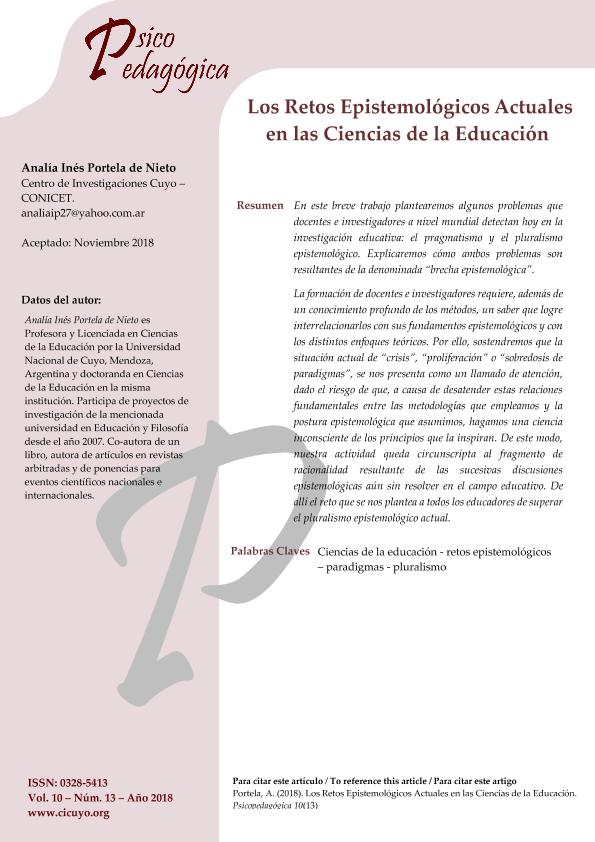
En este breve trabajo plantearemos algunos problemas que docentes e investigadores a nivel mundial detectan hoy en la investigación educativa: el pragmatismo y el pluralismo epistemológico. Explicaremos cómo ambos problemas son resultantes de la denominada “brecha epistemológica”. La formación de docentes e investigadores requiere, además de un conocimiento profundo de los métodos, un saber que logre interrelacionarlos con sus fundamentos epistemológicos y con los distintos enfoques teóricos. Por ello, sostendremos que la situación actual de “crisis”, “proliferación” o “sobredosis de paradigmas”, se nos presenta como un llamado de atención, dado el riesgo de que, a causa de desatender estas relaciones fundamentales entre las metodologías que empleamos y la postura epistemológica que asumimos, hagamos una ciencia inconsciente de los principios que la inspiran. De este modo, nuestra actividad queda circunscripta al fragmento de racionalidad resultante de las sucesivas discusiones epistemológicas aún sin resolver en el campo educativo. De allí el reto que se nos plantea a todos los educadores de superar el pluralismo epistemológico actual.
dc.description.abstract
This brief article will raise some problems that teachers and researchers worldwide now detected in educational research: pragmatism and epistemological pluralism. Explain how the two problems are the result of the so-called "epistemological gap". The training of teachers and researchers, as well as a thorough knowledge of the methods, requires a knowledge that achieves interrelate these with its epistemological basics and with different theoretical approaches. Therefore, we will argue that the current situation of "crisis", "proliferation" or "overdose" of paradigms, is presented as a warning, given the risk that, because of neglecting these fundamental relationships between the methodologies we use and epistemological stance we take, we do a science unaware of the principles that inspired it. In this way our activity is confined to the rationality fragment resulting from successive unresolved epistemological discussions in the educational field. From there the challenge facing all educators is to overcome the current epistemological pluralism.
dc.format
application/pdf
dc.language.iso
spa
dc.publisher
Centro de Investigaciones Cuyo
dc.rights
info:eu-repo/semantics/openAccess
dc.rights.uri
https://creativecommons.org/licenses/by-nc-sa/2.5/ar/
dc.subject
EPISTEMOLOGÍA
dc.subject
EDUCACIÓN
dc.subject
CIENCIA
dc.subject
PROLIFERACIÓN
dc.subject.classification
Otras Ciencias de la Educación
dc.subject.classification
Ciencias de la Educación
dc.subject.classification
CIENCIAS SOCIALES
dc.title
Los retos epistemológicos actuales en las Ciencias de la Educación
dc.title
Epistemological current challenges in Educational Sciences
dc.type
info:eu-repo/semantics/article
dc.type
info:ar-repo/semantics/artículo
dc.type
info:eu-repo/semantics/publishedVersion
dc.date.updated
2022-12-05T15:06:50Z
dc.journal.volume
10
dc.journal.number
13
dc.journal.pagination
49-58
dc.journal.pais
Argentina
dc.journal.ciudad
Mendoza
dc.description.fil
Fil: Portela, Analía Inés. Consejo Nacional de Investigaciones Científicas y Técnicas. Centro Científico Tecnológico Conicet - Mendoza; Argentina. Centro de Investigaciones de Cuyo; Argentina
dc.journal.title
Psicopedagógica
dc.relation.alternativeid
info:eu-repo/semantics/altIdentifier/url/https://www.cicuyo.org/ojs/index.php/Psicoped/article/view/108
Archivos asociados

Tamaño:
398.2Kb
Formato:
PDF