Mostrar el registro sencillo del ítem
dc.contributor.author
Martínez, Sofía
dc.contributor.author
Sastre, Natalia
dc.contributor.author
Francino, Olga
dc.contributor.author
Maté, María Laura
dc.contributor.author
Sanchez Bruni, Sergio Fabian
dc.contributor.author
del Sole, Maria Jose
dc.contributor.author
Ferrer, Lluis
dc.date.available
2022-03-29T11:56:18Z
dc.date.issued
2020
dc.identifier.citation
Development of a qPCR to evaluate accurately the treatment response of dogs with demodicosis; 9th World Congress Of Veterinary Dermatology; Australia; 2020; 26-26
dc.identifier.uri
http://hdl.handle.net/11336/154007
dc.description.abstract
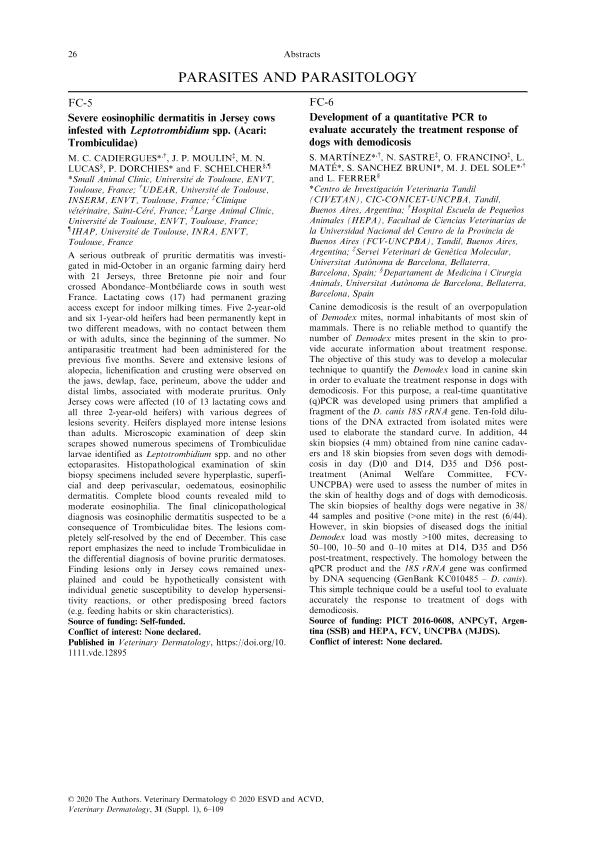
Canine demodicosis is the result of an overpopulation of Demodex mites, normal inhabitants of most skin of mammals. There is no reliable method to quantify the number of Demodex mites present in the skin to provide accurate information about treatment response. The objective of this study was to develop a molecular technique to quantify the Demodex load in canine skin in order to evaluate the conventional treatment response in dogs with demodicosis. For this purpose, a real time qPCR was developed using primers that amplified a fragment of the Demodex canis 18S rRNA gene. Ten-fold dilutions of the DNA extracted from isolated mites were used to elaborate the standard curve. In addition, 44 skin biopsies (4 mm) obtained from nine canine cadavers and 18 skin biopsies from seven dogs with demodicosis in days zero and 14, 35 and 56 post-treatment (Animal Welfare Committee, FCV-UNCPBA) were used to assess the number of mites in the skin of healthy dogs and of dogs with demodicosis. The skin biopsies of healthy dogs were negative in 38 samples, being positive (>one mite) the remaining samples (six). However, in skin biopsies of diseased dogs the initial Demodex load was mostly >100 mites, decreasing to 50-100, 10-50 and 0-10 mites at 14, 35 and 56 days post-treatment, respectively. The homology between the qPCR product and the 18S rRNA gene was confirmed by DNA sequencing (GenBank KC010485 - Demodex canis). This simple technique could be a useful tool to evaluate accurately the response to treatment of dogs with demodicosis.
dc.format
application/pdf
dc.language.iso
eng
dc.publisher
Wiley Blackwell Publishing, Inc
dc.rights
info:eu-repo/semantics/openAccess
dc.rights.uri
https://creativecommons.org/licenses/by-nc-sa/2.5/ar/
dc.subject
DEMODICOSIS
dc.subject
Q-PCR
dc.subject
MAMMALS
dc.subject
IVERMECTIN
dc.subject.classification
Otras Ciencias Veterinarias
dc.subject.classification
Ciencias Veterinarias
dc.subject.classification
CIENCIAS AGRÍCOLAS
dc.title
Development of a qPCR to evaluate accurately the treatment response of dogs with demodicosis
dc.type
info:eu-repo/semantics/publishedVersion
dc.type
info:eu-repo/semantics/conferenceObject
dc.type
info:ar-repo/semantics/documento de conferencia
dc.date.updated
2022-03-16T20:33:55Z
dc.identifier.eissn
1365-3164
dc.journal.volume
31
dc.journal.number
S1
dc.journal.pagination
26-26
dc.journal.pais
Reino Unido
dc.journal.ciudad
Londres
dc.description.fil
Fil: Martínez, Sofía. Consejo Nacional de Investigaciones Científicas y Técnicas. Centro Científico Tecnológico Conicet - Tandil. Centro de Investigación Veterinaria de Tandil. Universidad Nacional del Centro de la Provincia de Buenos Aires. Centro de Investigación Veterinaria de Tandil. Provincia de Buenos Aires. Gobernación. Comision de Investigaciones Científicas. Centro de Investigación Veterinaria de Tandil; Argentina
dc.description.fil
Fil: Sastre, Natalia. Universidad Autonoma de Barcelona. Facultad de Veterinaria; España
dc.description.fil
Fil: Francino, Olga. Universidad Autonoma de Barcelona. Facultad de Veterinaria; España
dc.description.fil
Fil: Maté, María Laura. Consejo Nacional de Investigaciones Científicas y Técnicas. Centro Científico Tecnológico Conicet - Tandil. Centro de Investigación Veterinaria de Tandil. Universidad Nacional del Centro de la Provincia de Buenos Aires. Centro de Investigación Veterinaria de Tandil. Provincia de Buenos Aires. Gobernación. Comision de Investigaciones Científicas. Centro de Investigación Veterinaria de Tandil; Argentina
dc.description.fil
Fil: Sanchez Bruni, Sergio Fabian. Consejo Nacional de Investigaciones Científicas y Técnicas. Centro Científico Tecnológico Conicet - Tandil. Centro de Investigación Veterinaria de Tandil. Universidad Nacional del Centro de la Provincia de Buenos Aires. Centro de Investigación Veterinaria de Tandil. Provincia de Buenos Aires. Gobernación. Comision de Investigaciones Científicas. Centro de Investigación Veterinaria de Tandil; Argentina
dc.description.fil
Fil: del Sole, Maria Jose. Consejo Nacional de Investigaciones Científicas y Técnicas. Centro Científico Tecnológico Conicet - Tandil. Centro de Investigación Veterinaria de Tandil. Universidad Nacional del Centro de la Provincia de Buenos Aires. Centro de Investigación Veterinaria de Tandil. Provincia de Buenos Aires. Gobernación. Comision de Investigaciones Científicas. Centro de Investigación Veterinaria de Tandil; Argentina
dc.description.fil
Fil: Ferrer, Lluis. Universidad Autonoma de Barcelona. Facultad de Veterinaria; España
dc.relation.alternativeid
info:eu-repo/semantics/altIdentifier/url/https://onlinelibrary.wiley.com/doi/epdf/10.1111/vde.12907
dc.relation.alternativeid
info:eu-repo/semantics/altIdentifier/doi/http://dx.doi.org/10.1111/vde.12907
dc.conicet.rol
Autor
dc.conicet.rol
Autor
dc.conicet.rol
Autor
dc.conicet.rol
Autor
dc.conicet.rol
Autor
dc.conicet.rol
Autor
dc.conicet.rol
Autor
dc.coverage
Internacional
dc.type.subtype
Congreso
dc.description.nombreEvento
9th World Congress Of Veterinary Dermatology
dc.date.evento
2020-10
dc.description.paisEvento
Australia
dc.type.publicacion
Journal
dc.description.institucionOrganizadora
World Association of Veterinary Dermatology
dc.source.revista
Veterinary Dermatology
dc.date.eventoHasta
2021-04
dc.type
Congreso
Archivos asociados

Tamaño:
84.56Kb
Formato:
PDF